2026-07-06 東京都立大学
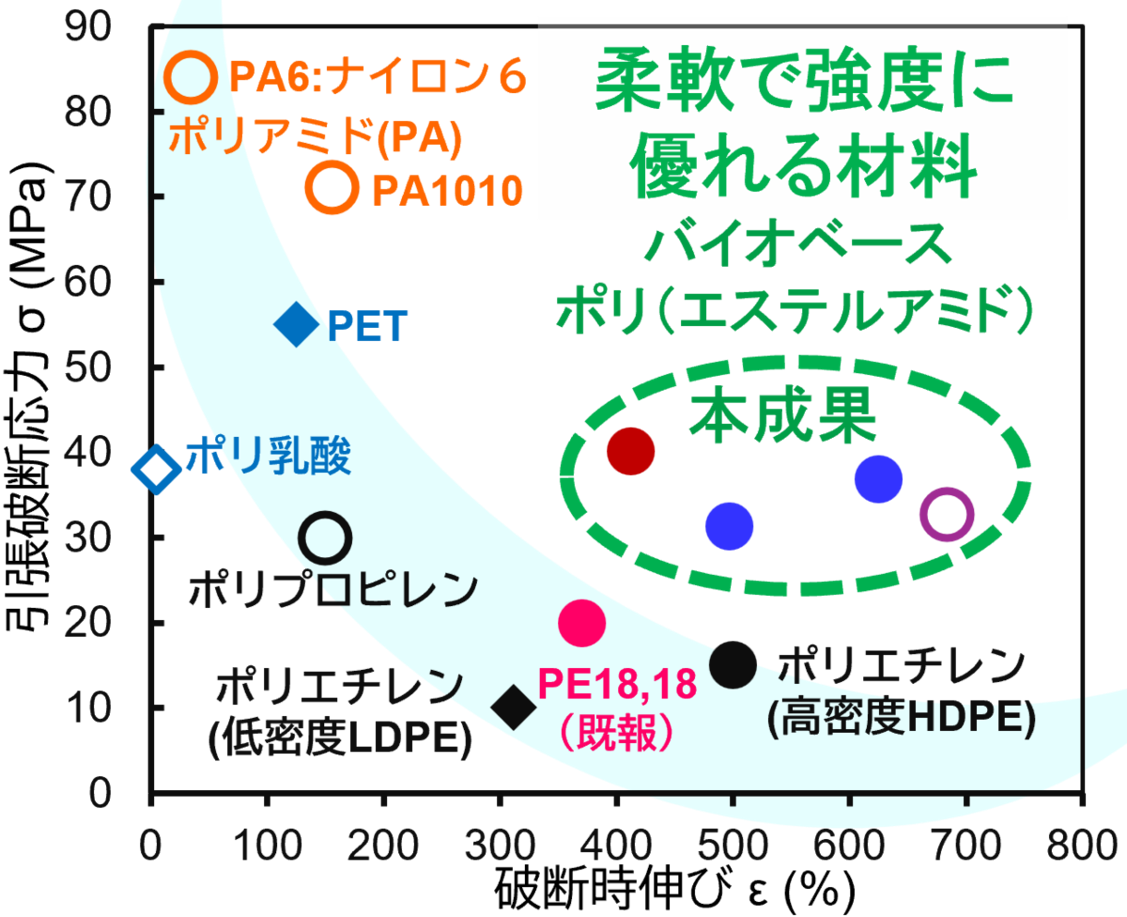
図1 今回開発したバイオベースポリ(エステルアミド)と汎用プラスチック(ポリエチレンやポリプロピレンなど)との機械特性(引張強度と破断時伸び)の比較。一般的に破断するまでの強度と伸びは二律背反関係にある。
<関連情報>
バイオベース脂肪族ポリ(エステルアミド)の合成、その熱特性、引張特性、およびエステル交換反応による選択的解重合 Synthesis of Biobased Aliphatic Poly(ester amide)s and Their Thermal, Tensile Properties, and Selective Depolymerization through Transesterification
Gaku Miyamoto,Mohamed Mehawed Abdellatif,Seiji Higashi,Kousaku Tao,Hiroki Takeshita,Hiroshi Hirano,and Kotohiro Nomura
JACS Au Published: July 7, 2026
DOI:https://doi.org/10.1021/jacsau.6c00515
Abstract
Development of chemically recyclable biobased polymers has been an important subject in terms of circular economy. In this study, syntheses of high-molecular-weight poly(ester amide)s consisting of diesters of 10-undecenol with dicarboxylic acids containing succinamide linkage with two L-phenylalanine (PEA1, HPEA1), L-leucine (PEA2, HPEA2), L-valine (PEA3, HPEA3), L-alanine (PEA4, HPEA4), and β-alanine (PEA5) have been demonstrated by acyclic diene metathesis (ADMET) polymerization and subsequent tandem olefin hydrogenation. The ADMET polymerization afforded high-molar-mass amorphous unsaturated polymers (PEA1–4, Mn = 39800–49300) or semicrystalline polymer containing β-alanine (PEA5, melting temperature at 116.6, 134.4 °C); the tandem hydrogenation gave the saturated poly(ester amide)s (HPEA1–4) without decreases in the Mn values. Thermal properties in the resultant polymers were affected by Mn values and amino acids in the monomer unit. These polymer films display promising tensile properties (strength, elongation at break) that were affected by the amino acid substituent; the properties in the saturated poly(ester amide)s (HPEA1–4) were also affected by the Mn values and the method of preparation (solvent cast, hot press). The films containing L-alanine (PEA4, HPEA4) showed high tensile strengths (31.5, 40.2 MPa, respectively), whereas the L-leucine-based polymer (HPEA2) exhibited high elongation at break (706–1000%). Unsaturated L-phenylalanine-based polymer film (PEA1) displayed promising tensile (32.8 MPa, 684%), elastic, and self-healing properties; the elastic behavior through hysteresis experiments of 10 cycles using reused test specimen was precisely reproduced. These poly(ester amide)s were depolymerized by transesterification to afford diesters containing the succinamides, demonstrating a closed loop chemical recycling.