2026-06-04 京都大学
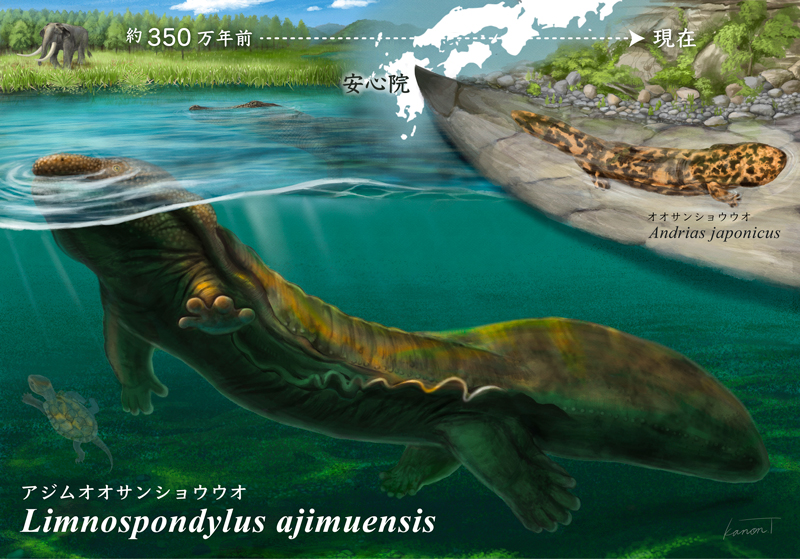
アジムオオサンショウウオの復元画。約350万年前、現在よりも温暖で湿潤な環境だった安心院地域の湖や沼に生息していたと考えられる。一方で、現在の安心院地域の河川には、現生の日本固有種オオサンショウウオ(Andrias japonicus)が生息している。©Kanon Tanaka
<関連情報>
⽇本の鮮新統から産出した有尾⽬オオサンショウウオ科の新属 A new genus of giant salamander (Urodela, Cryptobranchidae) from the Pliocene of Japan
Masahiro Noda, Masafumi Matsui, Kanto Nishikawa
PeerJ Published:June 3, 2026
DOI:https://doi.org/10.7717/peerj.21362
Abstract
The family Cryptobranchidae, commonly known as giant salamanders, originated at least by the Late Paleocene and has persisted to the present day. However, its fossil record is, extremely fragmentary, with few occurrences known from East Asia after the Miocene. Here we report three vertebral specimens of a cryptobranchid salamander from the Upper Pliocene Tsubusagawa Formation (around 3.5 Ma) of Oita Prefecture, Japan. These specimens were previously identified as Andrias sp., including extant species, but their taxonomic status remained unresolved. In this study, we re-examine the material and provide a more detailed description and attempt to resolve its taxonomic status. Our study demonstrates that it is a new taxon, Limnospondylus ajimuensis gen. et sp. nov., because it shows a unique combination of characters in the mid-trunk vertebra. This new giant salamander inhabited freshwater lacustrine environments and may have reached a total length of approximately 110 cm by around 18 years of age. The discovery of this new taxon helps to fill a significant gap in the Asian fossil record of this group. It also highlights the morphological and ecological diversity of Cryptobranchidae and provides essential implications for understanding their evolutionary history.