2026-06-02 中国科学院(CAS)
中国気象局の1961~2022年の日最高・最低気温データを用いた分析では、中国の大部分で昼間・夜間とも熱波の発生頻度が有意に増加しており、その主因は地表気温の上昇であることが示された。また、熱波と干ばつが同時発生する複合極端現象に対しては、地表気温の影響が熱波単独の場合よりも大きく、1991~2020年には人口増加と複合極端現象の強化によって人々の曝露リスクも増加した。さらに、CMIP6気候モデルを用いた将来予測では、全球平均気温が産業革命前比1.5℃および2.0℃上昇した場合、SSP245およびSSP585シナリオの双方で世界的に熱波の頻度と強度が増加すると予測された。
要因分析の結果、中程度排出シナリオ(SSP245)では地域的な地表気温が主要因である一方、高排出シナリオ(SSP585)では全球海面水温の寄与がより大きいことが判明した。研究は、地域ごとの人口曝露特性を考慮した適応策とリスク軽減策の必要性を示している。
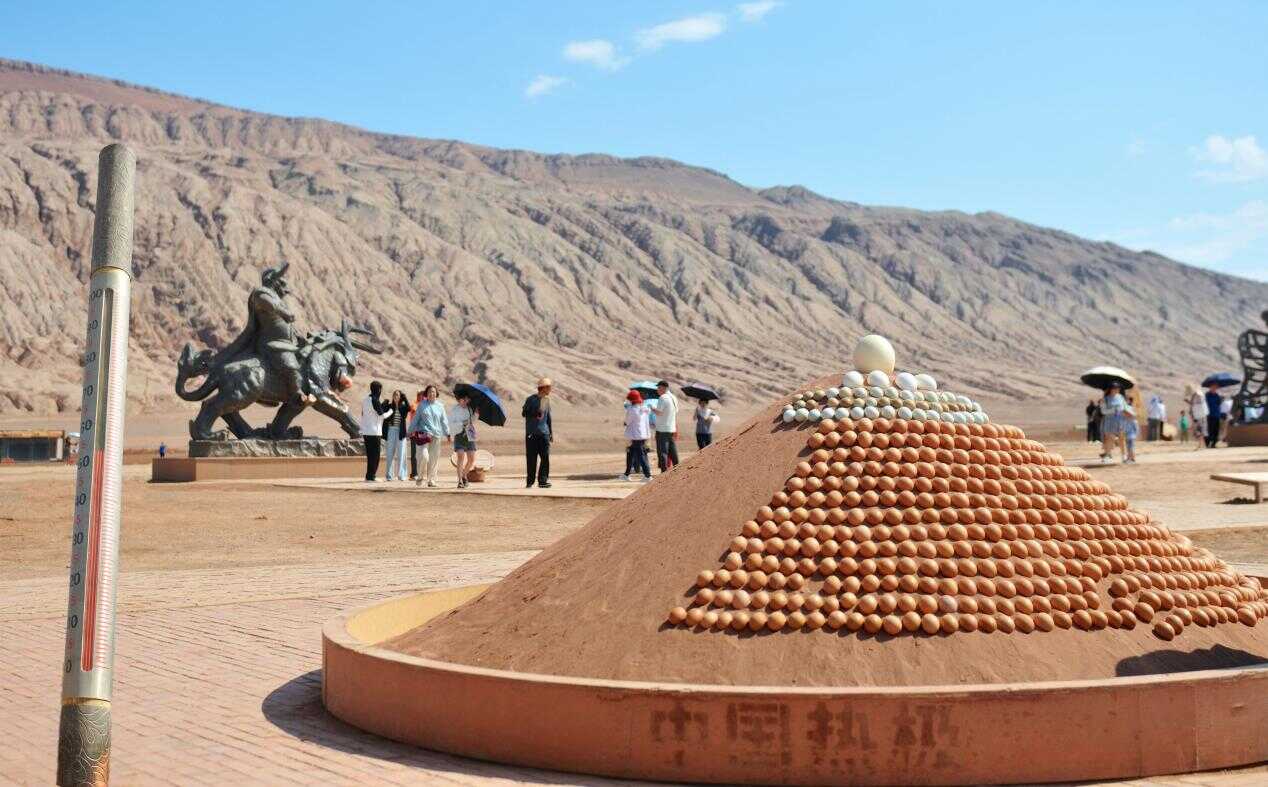
In Turpan’s Flaming Mountains, Xinjiang, the temperature exceeds 50°C, and the ground is hot enough to cook eggs directly. (Image by QIN Peihua)
<関連情報>
- https://english.cas.cn/newsroom/research-news/202606/t20260601_1160202.shtml
- https://www.sciencedirect.com/science/article/abs/pii/S0169809526003637
- https://rmets.onlinelibrary.wiley.com/doi/10.1002/qj.5045
1961年から2020年にかけての中国における複合的な熱波と干ばつ事象への曝露の増加 Increasing exposure to compound heatwave and drought events in China during 1961–2020
Peihua Qin, Zhenghui Xie, Binghao Jia
Atmospheric Research Available online: 20 May 2026
DOI:https://doi.org/10.1016/j.atmosres.2026.109099
Highlights
- Surface air temperature played a dominant role in driving compound HW–drought events.
- Compared with individual heatwaves, compound HW–drought events were more sensitive to climate warming.
- Population exposure to compound events substantially increased and the relative contributions varied across regions.
Abstract
Compound heatwave and drought (HW–drought) events exert more widespread and severe impacts than individual extremes. However, most previous studies have focused on their historical trends or physical mechanisms, while the relative importance of key climatic factors and the contributions of climate change and population to exposure changes remain limited. To address these gaps, this study aimed to clarify the spatiotemporal characteristics of compound HW–drought events across China during 1961–2020, identify their dominant climatic drivers, and quantify their population exposure and the contributions of their underlying components. Heatwaves were identified using daily maximum temperature with the 90th percentile threshold (TX90), while droughts were detected using the 6–month standardized precipitation evapotranspiration index (SPEI). Results showed that HW–drought events have become more frequent and widespread since 1961, driven by an initial decrease followed by a pronounced expansion of drought–affected areas and a continuous intensification of heatwaves. Furthermore, surface air temperature (Tas) played a dominant role in driving HW–drought occurrences, with a stronger impact than that on heatwaves alone, while precipitation exerted a negative regulatory effect, particularly in the South China (SC). Population exposure to HW–droughts increased markedly across all four subregions of China during 1991–2020 relative to 1961–1990, driven by both population growth and prolonged HW–drought duration. Regionally, compound HW–drought frequency contributed 46% to exposure increase over the Tibetan Plateau (TP), while population growth accounted for 52% of the increase in SC. These findings indicate that HW–drought events will likely intensify further under a warming climate, posing greater risks than isolated heatwaves, and highlight the need for targeted risk mitigation strategies.
中国における昼夜熱波の要因の相対的重要性 Relative importance of driving factors for daytime and nighttime heatwaves in China
Peihua Qin, Zhenghui Xie, Binghao Jia
Quarterly Journal of the Royal Meteorological Society Published: 28 August 2025
DOI:https://doi.org/10.1002/qj.5045
Abstract
The increasing frequency and intensity of heatwaves (HWs) present significant threats to human safety and natural ecosystems while the relative importance of their driving factors remains poorly understood. In this study, we first investigated the spatiotemporal variabilities of daytime and nighttime HWs across four subregions of China from 1961 to 2022. The daytime and nighttime heatwave number (HWN) and the number of HW days (HWF) were found to increase significantly during this period in most areas of China. To explore the underlying mechanisms, we examined the relationship between HW indices and eight potential driving factors: surface air temperature (T2M), soil moisture (SM), sensible heat flux (SH), latent heat flux (LH), surface net solar radiation (SW) and long-wave radiation (LW), El Niño-Southern Oscillation (ENSO) and Atlantic Multidecadal Oscillation (AMO). The long-duration linear trends of HWs and their driving factors were removed before investigating their relationships. The results showed that T2M, SH, SW, LW, and AMO were positively correlated with daytime HWs across all four subregions of China. The relative importance of these factors to HWs was then quantified using redundancy analysis and hierarchical partitioning. Among the eight factors, T2M was identified as the most significant effect on both daytime and nighttime HWs, that is, HWN, HWF and the length of the longest heatwave (HWD) over all subregions. The individual effects of T2M to daytime HWN were 40.08%, 63.24%, 19.17%, and 48.06% over NC, NW, SC, and TP regions, respectively. For nighttime HWN, its contributions were 64.22%, 69.98%, 28.61%, and 56.43% over the same regions, which were all significant at the 0.01 or 0.001 level. Additionally, SM or AMO was identified as another key factor influencing daytime or nighttime HWs in China. These findings highlight the critical drivers of HWs and provide valuable insights into the mechanisms underlying their occurrence in China.