
2026-04-14 ペンシルベニア州立大学(Penn State)
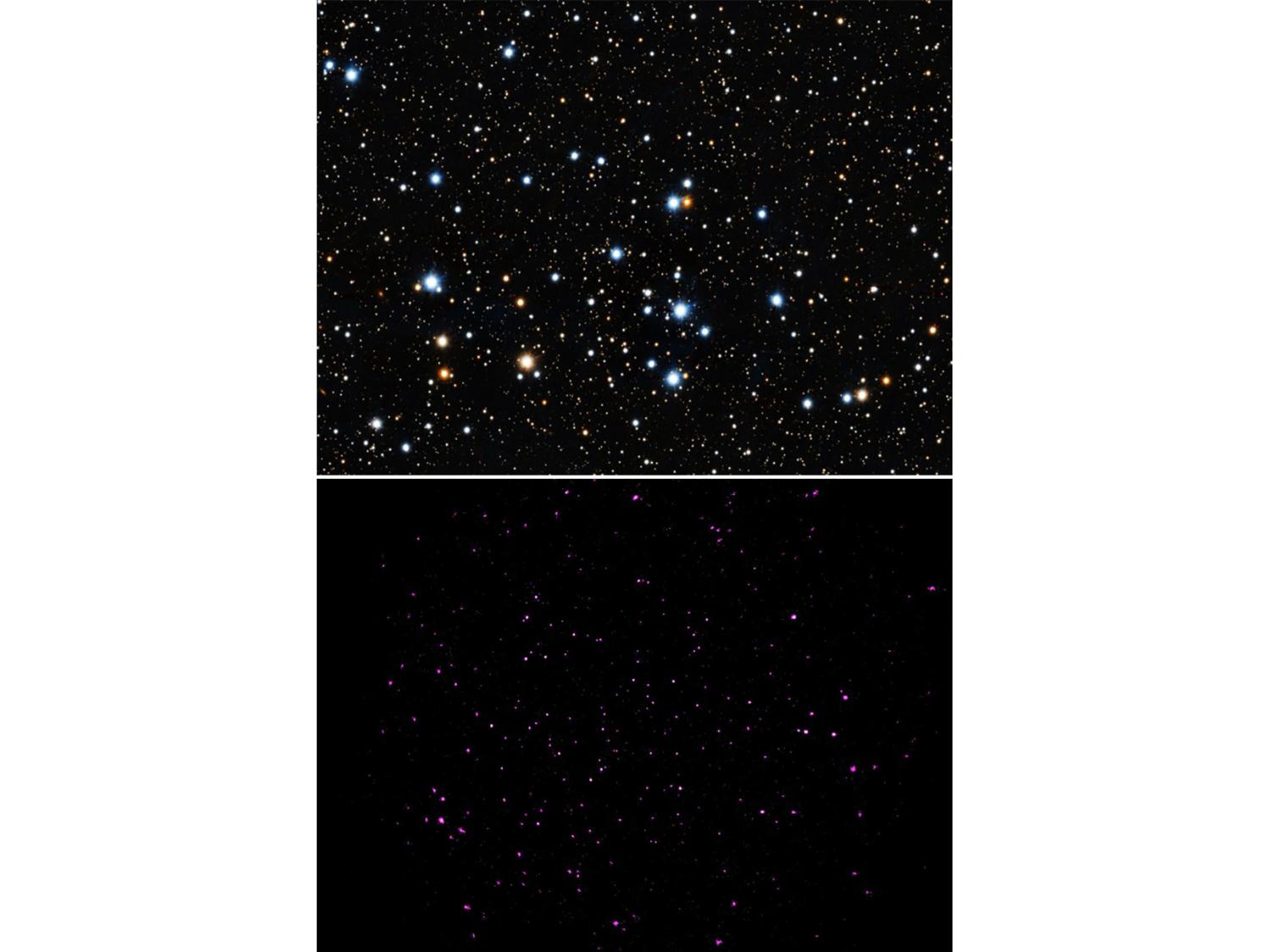
New study reveals that young stars that are similar in size to the sun dim in their x-ray emissions more than expected. Images show an example of one of the eight clusters studied, Trumpler 3. The top panel shows an optical/infrared view from PanSTARRS, a telescope located at Haleakala Observatory in Hawaii, capturing many stars in the field, including unrelated foreground and background stars. The bottom panel shows the same cluster in X-rays from NASA’s Chandra X-ray Observatory, which highlights mostly the young cluster members, though some fainter members remain undetected. The European Space Agency’s Gaia measurements of stellar distances and motions help astronomers identify these additional members and separate true cluster stars from unrelated stars. Credit: X-ray: NASA/CXC/Penn State Univ/K. Getman; Optical/IR: PanSTARRS; Image Processing:
<関連情報>
- https://www.psu.edu/news/eberly-college-science/story/dimming-x-rays-could-be-boon-life-planets-around-young-sun-stars
- https://iopscience.iop.org/article/10.3847/1538-4357/ae2e00
X-Ray Evolution of Young Stars: Early Dimming and Coronal Softening in Solar-mass Stars with Implications for Planetary Atmospheres
Konstantin V. Getman, Eric D. Feigelson, Vladimir S. Airapetian, and Gordon P. Garmire
The Astrophysical Journal Published: 2026 April 13
DOI:10.3847/1538-4357/ae2e00
Abstract
X-ray and ultraviolet (XUV) emission from young stars plays a critical role in shaping the evolution of planetary atmospheres and the conditions for habitability. To assess the long-term impact of high-energy stellar radiation, it is essential to empirically trace how X-ray luminosities and spectral hardness evolve during the first ≲1 Gyr, when atmospheric loss and chemical processing are most active. This study extends the X-ray activity–mass–age analysis of <25 Myr stars by K. V. Getman et al. (2022) to ages up to ∼750 Myr, using Gaia-based cluster memberships, new Chandra observations of five rich open clusters (∼45–100 Myr), and archival ROSAT and Chandra data for three older clusters (∼220–750 Myr). We find a mass-dependent decay in X-ray luminosity: solar-mass stars undergo a far more rapid and sustained decline, accompanied by coronal softening and the disappearance of hot plasma by ∼100 Myr, compared to their lower-mass siblings. These trends in solar-mass stars are likely linked to reduced magnetic dynamo efficiency and diminished ability to sustain large-scale, high-temperature coronal structures. The trends are significantly stronger than predicted by widely used XUV–rotation–age relations. The revised trends imply systematically lower rates of atmospheric mass loss and water photolysis, as well as altered ionization environments and chemical pathways relevant to the formation of prebiotic molecules, for planets in close orbits around solar analogs. These effects persist throughout at least the ≲750 Myr interval probed in this study.

