2026-05-14 金沢大学
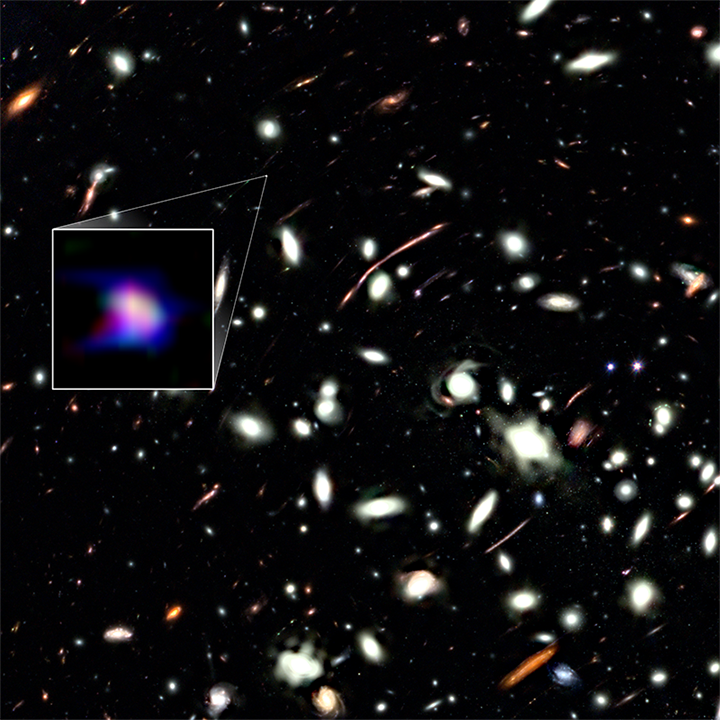
図1:巨大銀河団の「重力レンズ」が暴いた極小銀河LAP1-Bの素顔
(背景)JWSTの近赤外線カメラ(NIRCam)が捉えた巨大銀河団MACS J0416。
(拡大図)JWSTの近赤外線分光器(NIRSpec)のデータを基に作成した、LAP1-Bの「速度空間」3色合成画像。この銀河は星の数が少なく極めて暗いため、背景のカメラ画像(NIRCam)ではその姿を確認できませんが、分光観測によって、水素や酸素が放つ微弱な光(輝線)を捉えることに成功しました。拡大図の横軸は、ガスの運動(速度)、縦軸は、空間的な広がりを示しており、異なる元素の分布を可視化しています(青:水素のLyα輝線、緑:酸素の[OIII]輝線、赤:水素のHα輝線)。Lyα輝線は、各元素の分布を見やすくするため、表示上で速度を200 km/sオフセットさせています。 NASA, ESA, CSA & K. Nakajima et al., Nature
<関連情報>
宇宙再電離時代に形成中の、化学的に原始的な超低光度矮小銀河 An ultra-faint, chemically primitive galaxy forming in the reionization era
Kimihiko Nakajima,Masami Ouchi,Yuichi Harikane,Eros Vanzella,Yoshiaki Ono,Yuki Isobe,Moka Nishigaki,Takuji Tsujimoto,Fumitaka Nakamura,Yi Xu,Hiroya Umeda & Yechi Zhang
Nature Published:13 May 2026
DOI:https://doi.org/10.1038/s41586-026-10374-1
Abstract
The formation of the first stars and galaxies marked the onset of chemical enrichment, yet direct observations of such primordial systems remain elusive. Here we present James Webb Space Telescope spectroscopic observations of LAP1-B, an ultra-faint galaxy at redshift zspec = 6.625 ± 0.001, corresponding to a cosmic age of 800 million years after the Big Bang. This galaxy is strongly magnified by gravitational lensing. LAP1-B exhibits a gas-phase oxygen abundance of (4.2 ± 1.8) × 10−3 times the solar value, making it the most chemically primitive star-forming galaxy discovered to date. The galaxy displays an exceptionally hard ionizing radiation field, which is inconsistent with chemically enriched stellar populations or accreting black holes but matches theoretical predictions for an exceptionally metal-deficient stellar population1. It also shows an elevated carbon-to-oxygen abundance ratio for its metallicity in the interstellar medium, consistent with nucleosynthetic yields from a stellar population formed in the absence of initial metals2,3,4. The lack of detectable stellar continuum constrains the stellar mass to below 3,300 M⊙, and the dynamical mass, derived from emission-line kinematics, exceeds the combined stellar and gas mass, which indicates a dominant dark matter halo. Our findings establish LAP1-B as a ‘fossil in the making’, a direct high-redshift progenitor of the ancient ultra-faint dwarf galaxies observed in the local Universe and offers a rare window into the earliest stages of galaxy formation.