2026-07-06 東京科学大学
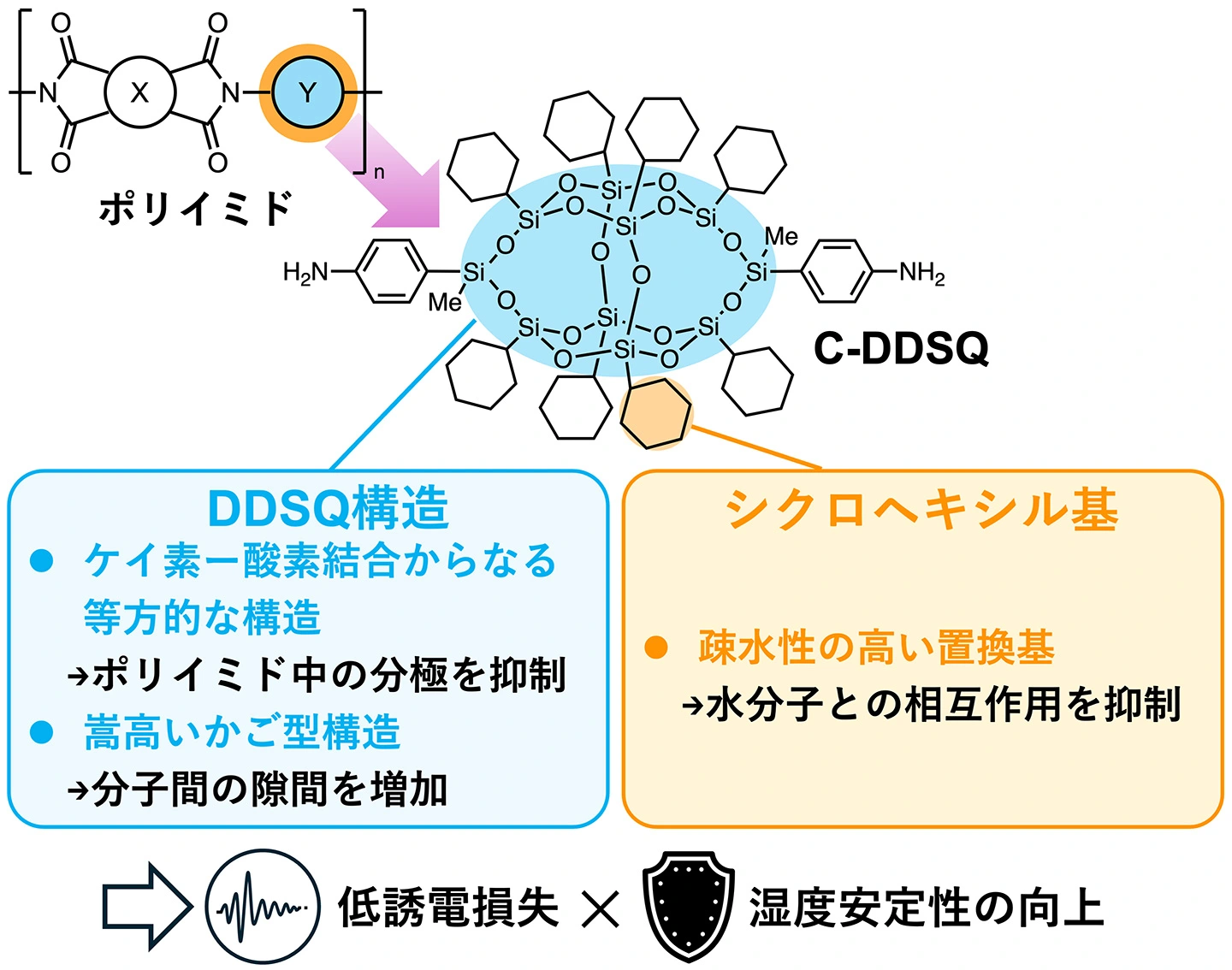
図1. C-DDSQを導入したポリイミドの分子設計指針
<関連情報>
10~20GHzで低誘電損失を示すシクロヘキシル置換二重デッカー型シルセスキオキサンを有する耐湿性半芳香族ポリイミド Humidity-robust semi-aromatic polyimides with cyclohexyl-substituted double-decker-shaped silsesquioxane exhibiting low dielectric losses at 10-20 GHz
Natsuko Sashi,Erina Yoshida,Hayato Maeda,Riku Takahashi,Kan Hatakeyama-Sato,Yuta Nabae,Masatoshi Tokita,Ririka Sawada,Shinji Ando & Teruaki Hayakawa
Communications Materials Published:06 July 2026
DOI:https://doi.org/10.1038/s43246-026-01217-7
Abstract
Emerging high-frequency electronics require polymer dielectrics that combine a low dielectric constant (Dk) with an ultra-low dissipation factor (Df) under realistic humidity. Here, we report semi-aromatic polyimides (PIs) incorporating cyclohexyl-substituted double-decker-shaped silsesquioxane (C-DDSQ) units that simultaneously suppress electronic and dipolar polarizations while limiting water uptake. The best formulation shows Dk = 2.57 and Df = 0.0019 at 10 GHz under 30% RH, and maintains minimal changes up to 60% RH (ΔDk ≈ 0.02, ΔDf ≈ 0.0003). Wide-angle X-ray diffraction confirms the retention of the cage-like silsesquioxane motif, and thermogravimetric analysis shows Td-10 ≥ 470 °C, indicating robust thermal endurance. Correlating Dk with in-plane refractive index (nTE) reveals that the lowered n and the rigid, hydrophobic architecture of C-DDSQ account for the low losses at 10–20 GHz. These results position C-DDSQ-incorporating semi-aromatic PIs as promising interlayer dielectrics that deliver ultra-low loss, humidity stability, and high thermal tolerance without resorting to porosity or heavy fluorination.