2026-07-08 筑波大学
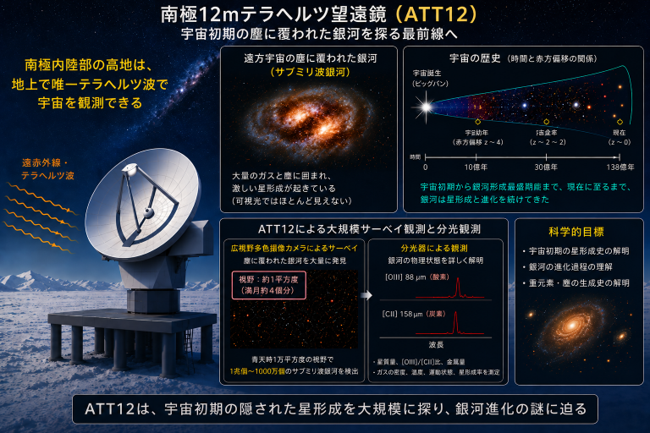
図1:本研究で評価した南極12mテラヘルツ望遠鏡(ATT12)の科学目標と観測の概要図 (ChatGPTを補助的に用いて作成)
<関連情報>
- https://www.tsukuba.ac.jp/journal/technology-materials/20260708140000.html
- https://www.tsukuba.ac.jp/journal/pdf/p20260708140000.pdf
- https://academic.oup.com/pasj/article-abstract/78/3/1107/8662939
ATT12:塵に覆われた銀河を探るための南極12メートルテラヘルツ望遠鏡 I. 装置感度と期待される科学成果 ATT12: The Antarctic 12 m terahertz telescope for studies of dusty galaxies. I. Instrument sensitivity and science forecasts
Koki Wakasugi,Takuya Hashimoto,Nario Kuno,Yu Nagai,Naomasa Nakai,Ken Mawatari,Masumichi Seta,Shun Ishii,Shunsuke Honda,Mana Ito,…
Publications of the Astronomical Society of Japan Published:27 April 2026
DOI:https://doi.org/10.1093/pasj/psag048
Abstract
We present a feasibility study of the Antarctic 12 m Terahertz Telescope (ATT12), a next-generation facility to be constructed at New Dome Fuji in Antarctica, designed to open up the far-infrared and terahertz windows for extragalactic astronomy. While ATT12 will enable a wide range of Galactic and extragalactic science, this paper focuses on its potential for studies of dusty star-forming galaxies (DSFGs) across cosmic time. Using realistic atmospheric transmission models and the planned instrumental specifications of heterodyne spectrometers and wide-field multi-color continuum cameras, we assess the expected sensitivity and scientific capabilities of ATT12. We show that spectroscopic observations will enable detections of [C ii] 158μm from galaxies with log(LIR/L⦿) ≳ 12 out to z∼7 , while [O iii] 88μm will remain observable for HyLIRG-class systems (logLIR/L⦿ ≳ 13) up to z∼10 . Line ratios including [O iii] 52/88μm, [N ii]122/205μm, and [O iii]/[N iii] will provide unique diagnostics of electron density and O/Nabundance at z∼4–8. Wide-field continuum surveys with the continuum cameras (KIDS-1/2; 300–850 GHz) will reach confusion-limited depths of ∼1–2 mJy over 10000 deg, detecting of order 106–107 DSFGs with LIR ≳ 1012L⦿ at z≲5 and ≲103–104 HyLIRGs with LIR ≳ 1013 up to z∼7 or even higher. Higher-frequency MKID cameras (KIDS-3/4; >850 GHz) are designed for targeted follow-up observations and to extend coverage toward the THz regime. Taken together, ATT12 will provide the first statistically representative samples of dusty galaxies across cosmic time and, through synergy with ALMA, JWST, and the proposed FIR Probe PRIMA, will establish a multi-wavelength framework in which ATT12 discovers large samples through wide-area surveys, ALMA provides high-resolution follow-up of gas and ISM structure, JWST probes stellar populations and metallicity in the rest-frame optical/near-infrared, and PRIMA delivers ultra-sensitive far-infrared spectroscopy from space.