2026-06-03 マサチューセッツ工科大学(MIT)
<関連情報>
- https://news.mit.edu/2026/mit-chemists-design-impact-resistant-plastics-0603
- https://www.nature.com/articles/s41586-026-10557-w
メカノフォア架橋はポリマーの弾道エネルギー散逸を向上させる Mechanophore cross-linking enhances ballistic energy dissipation of polymers
Zhen Sang,Suong T. Nguyen,Kwangwook Ko,Senpeng Lin,Heecheol Jang,Simon Gonzalez-Zapata,Sullivan Fitz,Yun Kai,Steven Kooi,Chuting Deng,Monica Olvera de la Cruz,Marisol Koslowski,Heather J. Kulik,Stephen L. Craig,Keith A. Nelson & Jeremiah A. Johnson
Nature Published:03 June 2026
DOI:https://doi.org/10.1038/s41586-026-10557-w
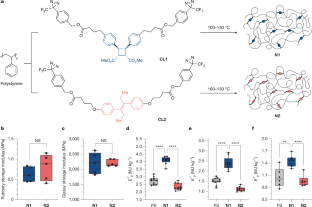
Fig. 1: Design and mechanical properties of PS networks under quasi-static and high-rate testing.
Abstract
Mechanical failure is a marked limitation for plastics used in structural, protective and coating applications. In particular, perforation under high-rate deformation is difficult to mitigate through conventional molecular design1,2. Cross-linking is widely used to improve the thermal and chemical stability of polymers, yet under mechanical deformation, it typically renders materials more brittle, limiting impact resistance and functional lifetime3. Overcoming this fundamental trade-off between stability and toughness remains a central challenge. Here we demonstrate that embedding a small fraction of force-sensitive mechanophores as cross-links into common polymers fundamentally reverses this trade-off, producing materials with substantially enhanced ballistic energy dissipation. At strain rates exceeding 107 s−1, we show that mechanophore-cross-linked networks absorb up to about 115% more energy than conventional thermosets and surpass even their uncross-linked thermoplastic counterparts. We attribute this behaviour to a force- and adiabatic-heating-driven local thermoset-to-thermoplastic transition, in which selective mechanophore scission facilitates viscoplastic deformation at the impact site while preserving network integrity in the surrounding regions. We demonstrate the generality of this strategy in both glassy polystyrene and rubbery styrene–butadiene–styrene triblock copolymers. These results establish mechanophore cross-linking as a design principle for converting commodity polymers into impact-resilient materials and open directions at the intersection of polymer mechanochemistry and extreme-strain-rate material behaviour.