2026-07-08 カリフォルニア大学アーバイン校(UCI)
◆研究では、ニューラルネットワークに物理的制約を組み込み、AIがイベントを分類するだけでなく、その判断根拠を研究者が理解できる仕組みを構築した。これにより、ブラックボックス型AIに比べて信頼性と解釈性を向上させ、ニュートリノ振動や粒子相互作用の解析精度を高められることが示された。さらに、本手法は将来の大規模ニュートリノ実験で膨大な観測データを効率よく解析する基盤となるだけでなく、高エネルギー物理学や宇宙物理学など、複雑な物理現象を扱う幅広い研究分野への応用も期待されている。
<関連情報>
- https://news.uci.edu/2026/07/08/ai-takes-on-one-of-physics-biggest-mysteries/
- https://www.nature.com/articles/s42005-026-02688-3
高エネルギー物理学におけるニュートリノ事象分類のための視覚言語モデルの適用 Adapting vision-language models for neutrino event classification in high-energy physics
Dikshant Sagar,Kaiwen Yu,Alejandro Yankelevich,Jianming Bian & Pierre Baldi
Communications Physics Published:20 May 2026
DOI:https://doi.org/10.1038/s42005-026-02688-3
Abstract
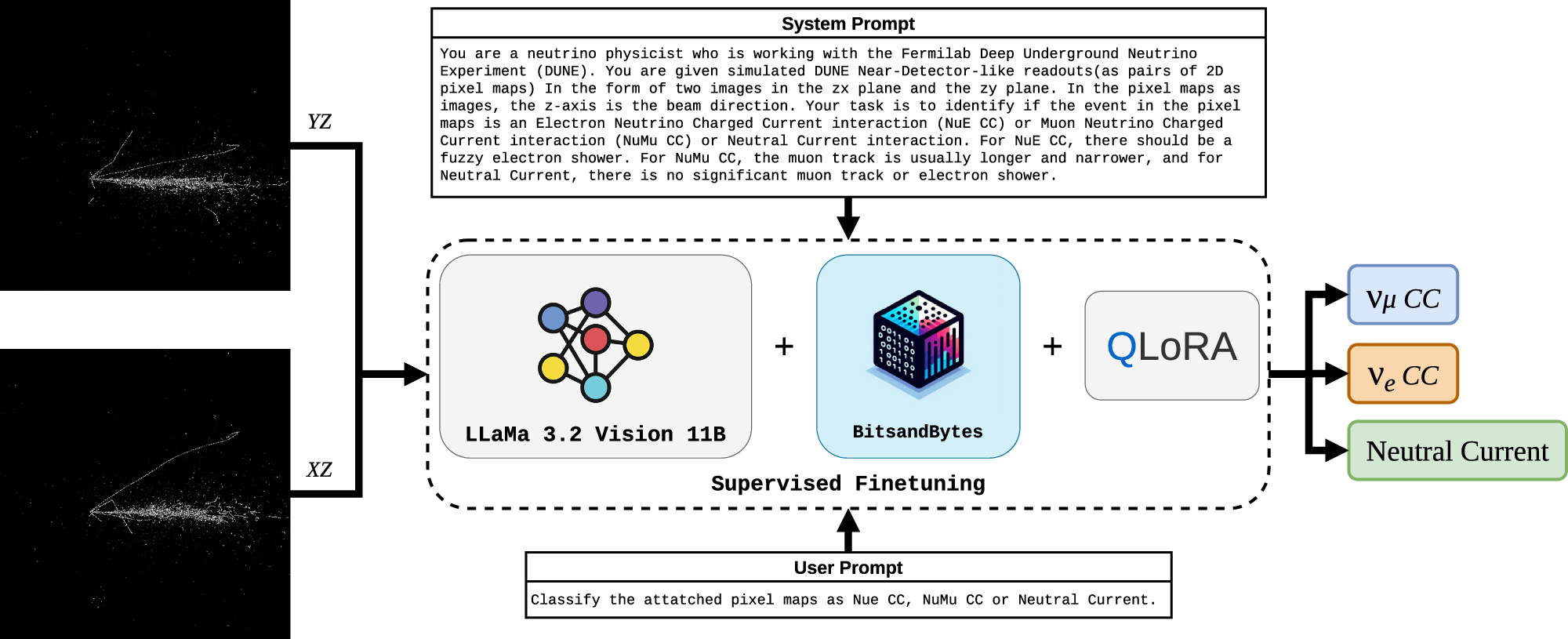
Recent advances in machine learning, particularly in multimodal models, have created new opportunities for analyzing complex data in high-energy physics, where accurate identification of particle interactions is critical for scientific discovery. However, existing approaches rely heavily on convolutional neural networks, which lack interpretability and do not fully leverage multimodal reasoning capabilities. Here we show that a fine-tuned Vision Language Model (VLM) based on LLaMA 3.2 can effectively identify neutrino interactions in pixelated detector data, outperforming both a state-of-the-art convolutional neural network and a Vision Transformer baseline in classification accuracy and robustness. In addition, the VLM provides improved explainability through reasoning-based, interpretable predictions and supports integration of auxiliary semantic information. These results demonstrate the potential of multimodal transformer architectures as general-purpose tools for physics event classification, paving the way for more transparent, flexible, and scalable analysis methods in future high-energy physics experiments.