2026-06-09 中国科学院(CAS)
◆研究では独自の観察セルを用いて、マクロボイド(大孔)とセル状細孔の形成過程を分離して解析した。その結果、マクロボイドは流体力学的不安定性に起因し、界面形状の制御によって成長を調節できることを明らかにした。一方、セル状細孔は熱力学的要因によって形成され、その面積密度を熱力学パラメータと関連付ける定量モデルを構築した。さらに、膜形成速度と溶媒・非溶媒間の相互拡散との本質的関係を解明し、構造と性能の相関を明らかにした。この知見を活用して作製した超薄膜は、高い選択性と導電性を両立し、バナジウムレドックスフロー電池に適用した際、220mA/cm²の電流密度で80%超のエネルギー効率を達成した。研究は高性能膜材料の合理的設計に新たな指針を与える成果である。
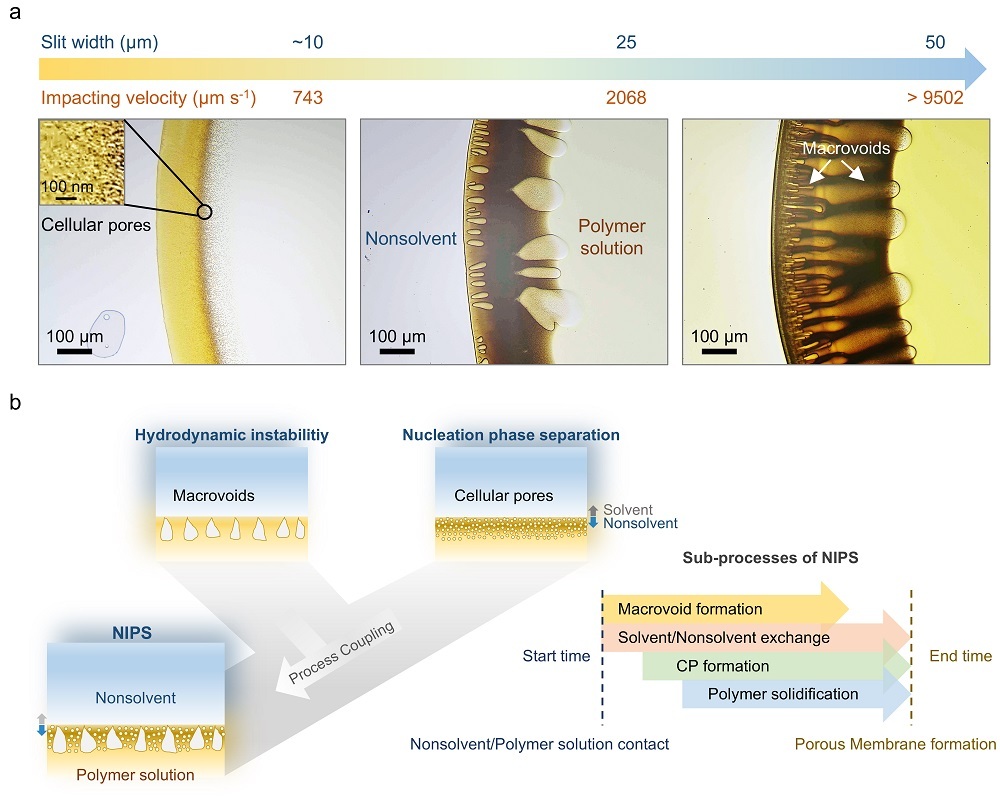
Decoupled formation of macrovoids and cellular pores and the underlying NIPS mechanism. (Image by JIA Chaoyang and LU Wenjing)
<関連情報>
- https://english.cas.cn/newsroom/research-news/202606/t20260609_1161418.shtml
- https://academic.oup.com/nsr/advance-article/doi/10.1093/nsr/nwag306/8696162
古典的な非溶媒誘起相分離理論を拡張して膜孔を制御する Extending the theory of classical nonsolvent induced phase separation to regulate membrane pores
Chaoyang Jia,Chenkai Mu,Yiwen Chen,Hongjun Zhang,Willem Verfaillie,Scout Caspers,Ivo F J Vankelecom,Wenjing Lu,Xianfeng Li
National Science Review Published:27 May 2026
DOI:https://doi.org/10.1093/nsr/nwag306
Abstract
Nonsolvent induced phase separation, employed for over 60 years to prepare porous membranes, still has unclear pore formation mechanisms due to coupled variables. Classical theory links the distinct pore morphologies, i.e. macrovoids or cellular pores, to instantaneous and delayed phase separation, respectively. However, when the formations of macrovoids and cellular pores were decoupled in a tunable device that regulates the nonsolvent hydrodynamics, it was proven that hydrodynamic instability drives macrovoid formation, while cellular pores form via a nucleation-growth mechanism. By establishing a quantitative relationship between nonsolvent and area density of cellular pores, we achieved further optimization of the membrane morphology, enabling its application in vanadium flow batteries with significantly enhanced performance. This work extends the theory of phase separation and provides a causality-driven framework for precision membrane design.