2026-06-15 東北大学
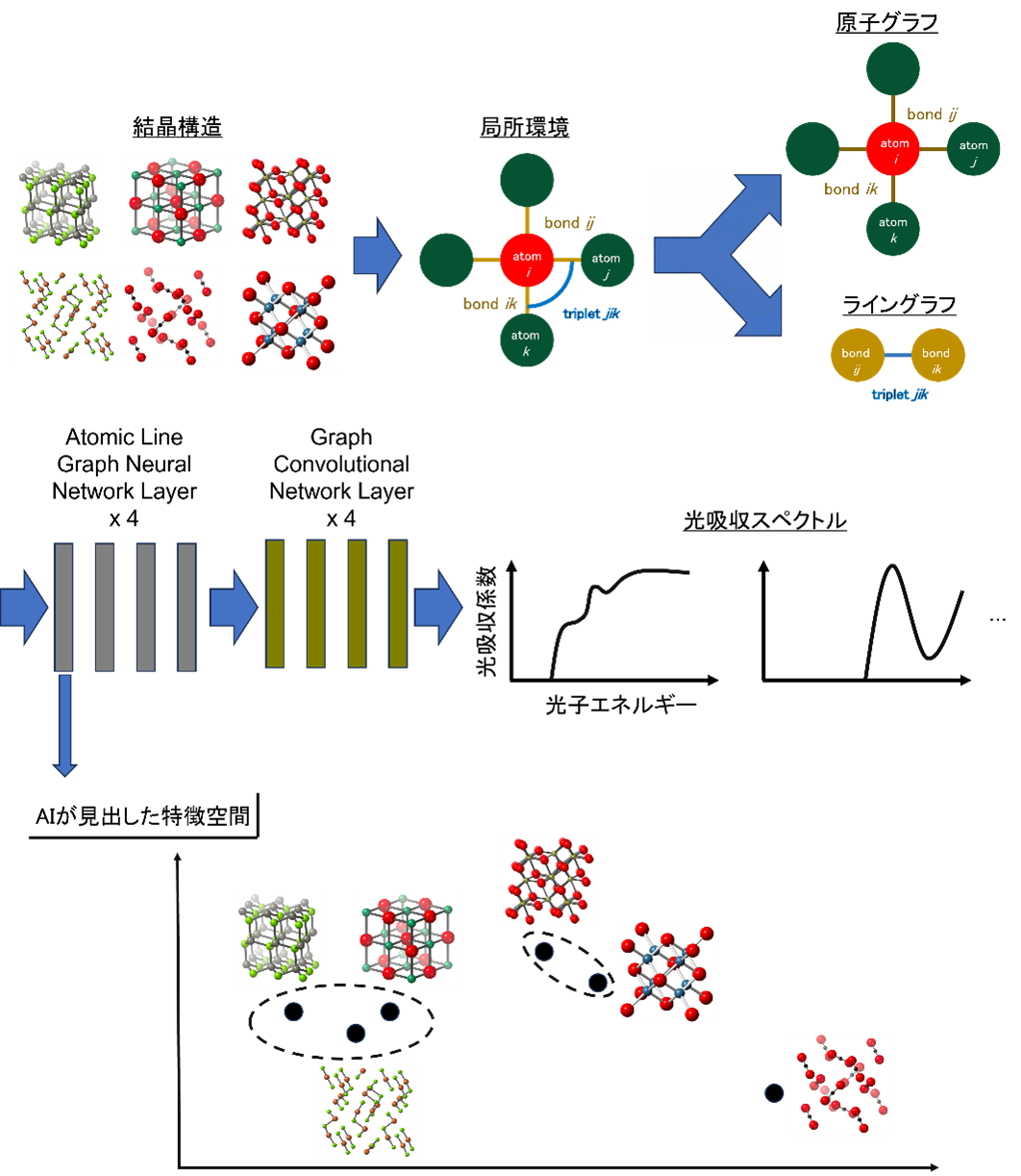
図1 本研究で提案した手法の概略図
<関連情報>
- https://www.tohoku.ac.jp/japanese/2026/06/press20260615-web01-xai.html
- https://advanced.onlinelibrary.wiley.com/doi/10.1002/aidi.202600007
深層学習に基づく高次元データからの有望な材料グループと共通特徴の抽出:無機結晶の光スペクトルの事例 Deep Learning–Based Extraction of Promising Material Groups and Common Features from High-Dimensional Data: A Case of Optical Spectra of Inorganic Crystals
Akira Takahashi, Yu Kumagai, Arata Takamatsu, Fumiyasu Oba
Advanced Intelligent Discovery Published: 14 June 2026
DOI:https://doi.org/10.1002/aidi.202600007
Abstract
We report an interpretation method for deep learning models that allows us to handle high-dimensional spectral data in materials science. The proposed method uses feature extraction and clustering analysis to categorize materials into classes based on similarities in both spectral data and chemical characteristics such as elemental composition and atomic arrangement. As a demonstration, we apply this method to an atomistic line graph neural network (ALIGNN) model trained on first-principles calculation data of 2681 metal oxides, chalcogenides, and related compounds for optical absorption spectrum prediction. Our analysis reveals key elemental species and their coordination environments that influence optical absorption onset characteristics. The method proposed herein is broadly applicable to the classification and interpretation of diverse spectral data, extending beyond the optical absorption spectra of inorganic crystals.