2026-07-22 北京大学(PKU)
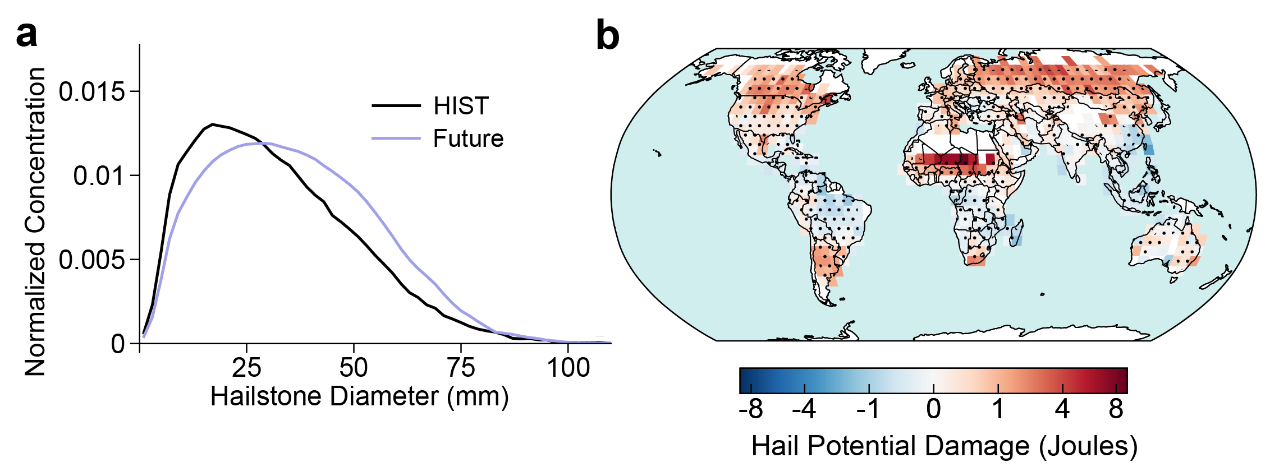
Figure 1. (a) Near-surface hail size distributions under historical and future climate scenarios; (b) Spatial distribution of projected changes in global hail damage potential under the SSP5-8.5 scenario.
<関連情報>
- https://newsen.pku.edu.cn/news_events/news/research/15622.html
- https://www.nature.com/articles/s41586-026-10543-2
温暖化が進む世界における雹による被害の可能性の高まり Rising global hail damage potential in a warming world
Shiyi Zhang (张诗怡),Qinghong Zhang (张庆红),John T. Allen & Xiangyu Lin (林翔宇)
Nature Published:27 May 2026
DOI:https://doi.org/10.1038/s41586-026-10543-2
Abstract
Anthropogenic climate change (ACC) is expected to modify severe convective storms and their associated hazards, including hailstorms, a primary driver of weather-related economic losses1,2,3,4. Despite some research on the response of hailstorms to ACC, most studies have focused on regional-scale changes2,3,4,5,6,7,8,9, whereas global-scale assessments of hailstone size remain scarce. Here we show a 36.5–42.1% increase in global hailstorm-induced damage potential by the late twenty-first century, with the magnitude determined by the emission scenario. Our results arise from hailstone trajectory simulations conducted under historical and future scenarios, driven by EC-Earth3 ensemble outputs10 that are cross-validated through multimodel comparisons. Globally, increased low-level temperature and specific humidity drive a shift towards larger hailstones, with the frequency of ≥30-mm-diameter hailstones rising by 37.9–51.8% and <30-mm-diameter hailstones declining by 4.2–12.3%. Regionally, the mid-high latitudes predominantly exhibit increased hail damage potential owing to strong warming and weak moistening, amplifying instability sufficiently to counteract enhanced drag and melting effects. Conversely, tropical and monsoonal regions experience reduced hail damage potential owing to weak warming, strong moistening and limited hail growth depth. Our findings highlight the non-uniform impacts of ACC on global hailstorm damage, providing critical insights for future disaster prevention and mitigation strategies.