
2026-08-13 スタンフォード大学
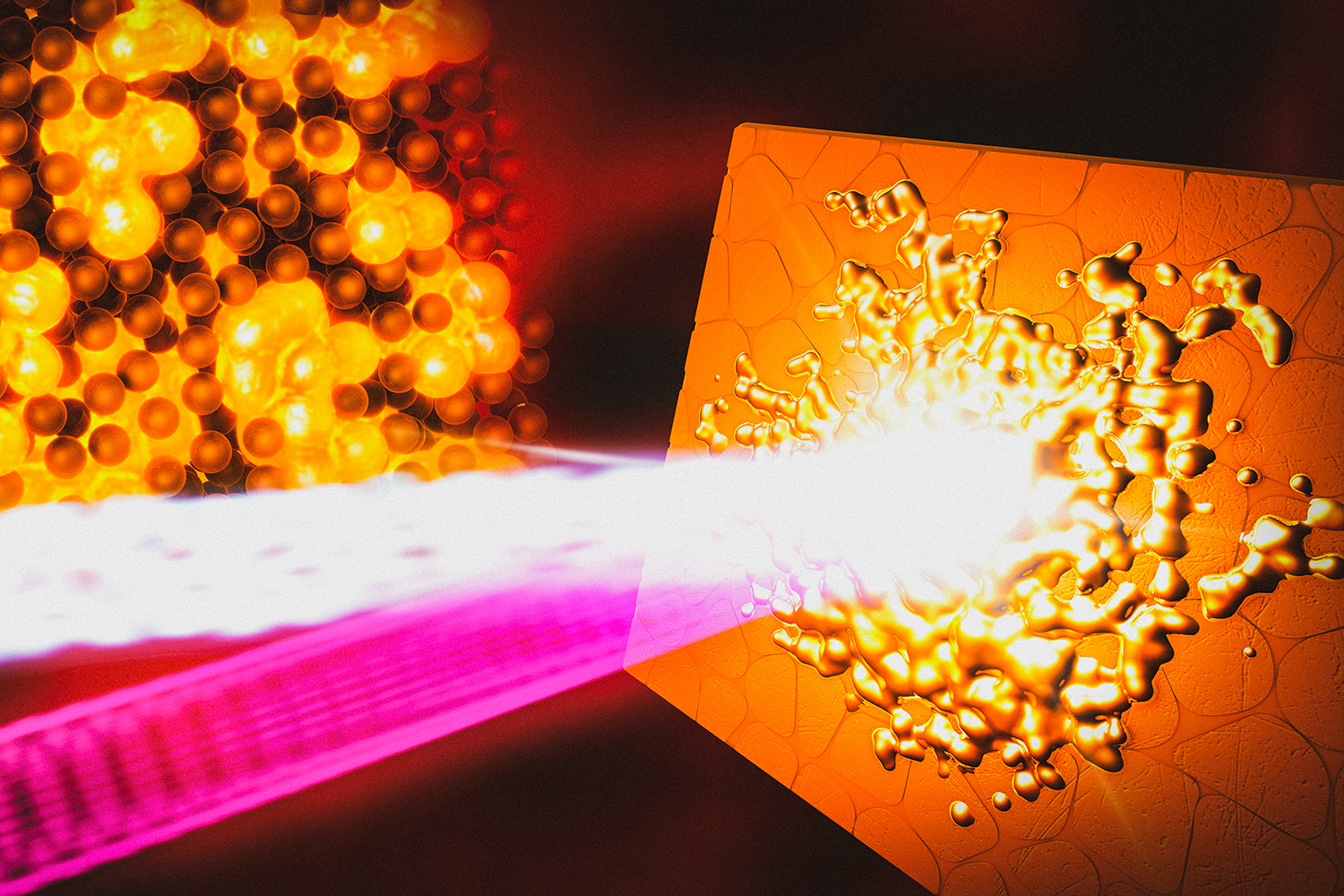
Researchers used SLAC’s electron camera to watch copper atoms melt in real time to understand their potential for use in future fusion power plants. They blasted a thin copper film with laser heat, then sent an electron beam to image the sample as it heated. The team uncovered a key parameter that allowed the copper’s crystal lattice to deteriorate slowly instead of collapsing as predicted. | Greg Stewart / SLAC National Accelerator Laboratory
<関連情報>
- https://news.stanford.edu/stories/2026/08/copper-extreme-heat-research-fusion-reactors
- https://www.nature.com/articles/s41467-026-75970-1
フェムト秒電子回折による超高速融解の原子ダイナミクスの解明 Probing the atomic dynamics of ultrafast melting with femtosecond electron diffraction
M. Z. Mo,M. B. Maigler,T. Held,B. K. Ofori-Okai,A. Bergermann,Z. Chen,R. K. Li,X. Shen,K. Sokolowski-Tinten,R. Redmer,X. J. Wang,J. Schein,D. O. Gericke,B. Rethfeld & S. H. Glenzer
Nature Communications Published:06 August 2026
DOI:https://doi.org/10.1038/s41467-026-75970-1 Unedited version
Abstract
Melting is an every-day phase transition that is determined by thermodynamic parameters like temperature and pressure. In contrast, ultra-fast melting is governed by the microscopic response to a rapid energy input and, thus, can reveal the strength and dynamics of atomic bonds as well as the energy flow rate to the lattice. Accurately describing these processes remains challenging and requires detailed insights into transient states encountered. Here, we present data from femtosecond electron diffraction measurements that capture the structural evolution of copper during the ultrafast solid-to-liquid phase transformations. At absorbed energy densities 2-4 times the melting threshold, melting begins at the surface slightly below the nominal melting point followed by rapid homogeneous melting throughout the volume. Molecular dynamics simulations reproduce these observations and reveal a weak electron-lattice energy transfer rate for the given experimental conditions. Both simulations and experiments show no indications of rapid lattice collapse when its temperature surpasses proposed limits of superheating, providing evidence that the inherent dynamics limits the speed of disordering in ultrafast melting of metals.

