2026-06-15 中国科学院(CAS)
<関連情報>
- http://english.xao.cas.cn/news/202606/t20260615_1163614.html
- https://agupubs.onlinelibrary.wiley.com/doi/10.1029/2025JA034421
太陽フレア終結衝撃波が地表レベルの増強を引き起こす役割を調査する Investigating the Role of Solar Flare Termination Shocks in Initiating Ground Level Enhancements
Xin Wang, Yi-Hua Yan, Xue-Shang Feng, Su-Ming Weng, Hong Lu
Journal of Geophysical Research:Space Physics Published: 25 May 2026
DOI:https://doi.org/10.1029/2025JA034421
Abstract
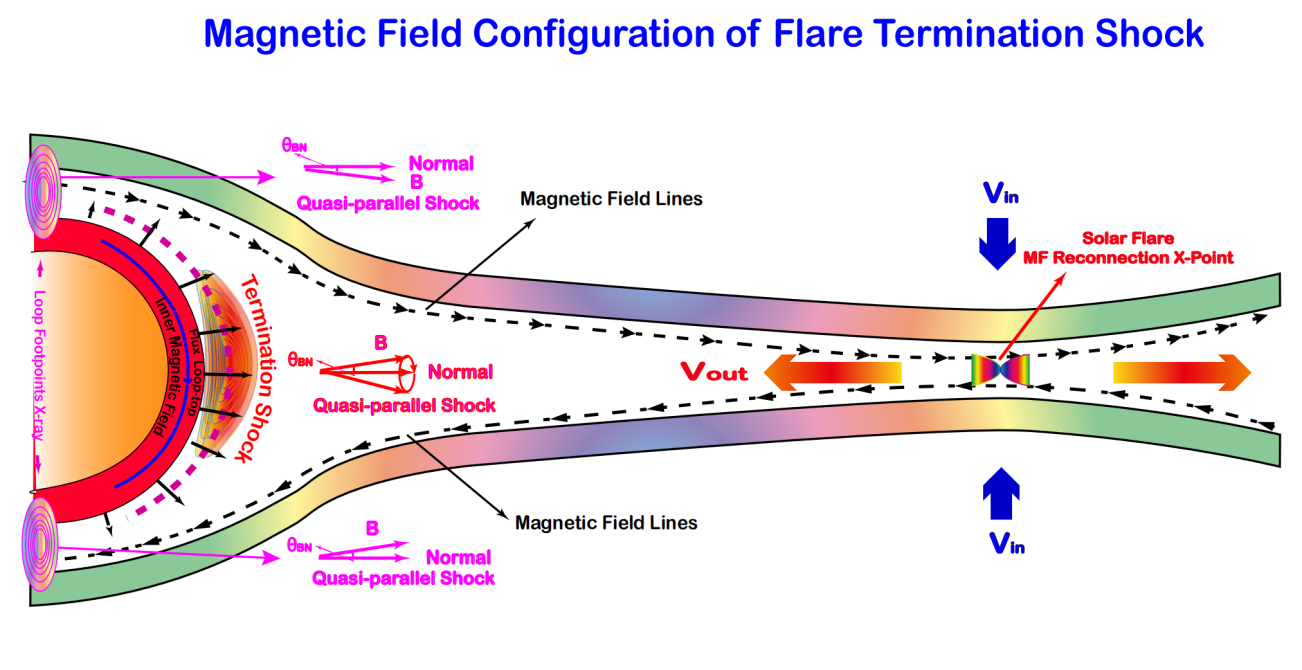
The solar flare is the primary source of eruptions that generate space weather. Its high-speed jet is believed to produce the potential termination shock (TS) at the apex of the magnetic flux loop. Within the solar atmosphere, it becomes particularly intriguing to explore the fundamental mechanisms responsible for the initial acceleration of particles and their role in the generation of solar energetic particles (SEPs), extending to the phenomenon known as ground level enhancement (GLE). This study focuses on uncovering the relationship between GLE events and the flare-TS. To achieve this, we employ a Dynamic Monte Carlo (DMC) simulation technique to model the behavior of the flare-TS. In this theoretical framework, thermal particles that are part of the high-speed outflow from magnetic reconnection events penetrate the shock front at the loop top. Through numerous cycles of interaction with the TS, these particles undergo successive energy gains. Consequently, our simulation reveals details of the energy spectral structure. Besides the standard power-law with a hard index below 2 MeV, the emergence of a “bump-on-tail” structure between 2 and 20 MeV is observed in the simulated accelerated protons. Additionally, the efficiency of the TS acceleration dependent on the speed of the input bulk flow suggests a potential SEPs source for boosting GLEs. Based on these findings, we suggest that the termination shock acceleration mechanism serves as an initial source of energetic particles, which would lead to GLEs directly or seed the subsequent interplanetary processes for GLEs indirectly.
Plain Language Summary
When auroras occur on Earth, they may be accompanied by “particle rain,” both resulting from intense solar activity. The “particle rain” reaching Earth’s surface is a Ground Level Enhancement (GLE) event, a special solar high—energy particle event triggered by protons over 450 MeV and confirmed by the Global Neutron Monitoring Network. GLEs usually originate from intense solar flares on the Sun’s surface. A major flare can release up to 1025 joules of energy, equivalent to the combined explosive force of 100 billion atomic bombs detonating simultaneously. This study uses the Monte Carlo particle method to simulate shock waves from flare plasma flows, demonstrating that they can transform low—energy charged particles into high—energy ones. High—energy protons from the solar source region travel through interplanetary magnetic field “channels.” In interplanetary space, shock waves from coronal mass ejections (CMEs) also accelerate them to GeV levels. When they reach Earth, they interact with the upper atmosphere, triggering particle showers and the GLE phenomenon detectable on the ground. The process from solar flare eruptions to GLE signals shows the extreme transfer of solar energy to Earth.