2026-04-08 東北大学
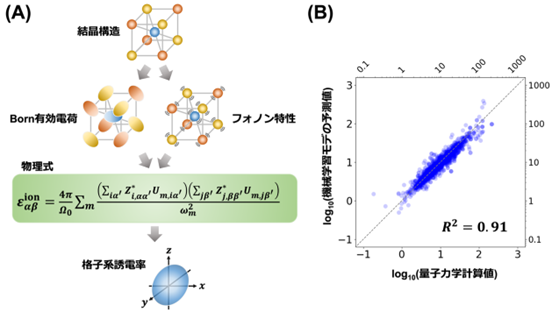
図1. (A)本研究において構築した機械学習を用いた予測手法の概略図。
<関連情報>
- https://www.tohoku.ac.jp/japanese/2026/04/press20260408-02-AI.html
- https://www.tohoku.ac.jp/japanese/newimg/pressimg/tohokuuniv-press20260408_02web_AI.pdf
- https://journals.aps.org/prx/abstract/10.1103/28wr-w896
イオン誘電率テンソルを予測するための物理ベースの因数分解機械学習 Physics-Based Factorized Machine Learning for Predicting Ionic Dielectric Tensors
Atsushi Takigawa, Shin Kiyohara, and Yu Kumagai
Physical Review X Published: 7 April, 2026
DOI: https://doi.org/10.1103/28wr-w896
Abstract
Considerable effort continues to be devoted to the exploration of next-generation high- materials that combine a high dielectric constant with a wide band gap. However, machine learning (ML)-based virtual screening has remained challenging, primarily due to the low accuracy in predicting the ionic contribution to the dielectric tensor, which dominates the dielectric performance of high- materials. We propose a joint ML model that predicts Born effective charges using an equivariant graph neural network, and phonon properties using a highly accurate pretrained ML potential. The ionic dielectric tensor is then computed analytically from these quantities. This approach significantly improves the accuracy of ionic contribution. Using the proposed model, we successfully identified 31 novel high- oxides from a screening pool of over 8000 candidates.