2026-10-13 早稲田大学
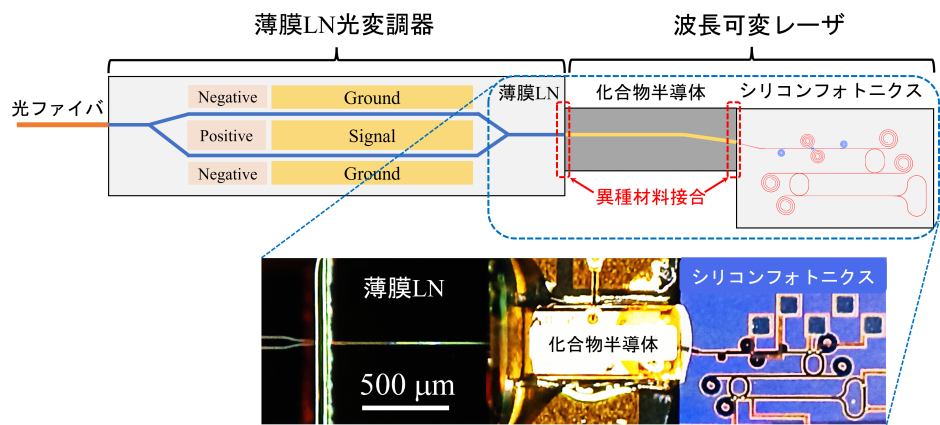
(図1) シリコンフォトニクス波長可変レーザと薄膜LN光変調器を集積化した小型・低消費電力の光送信器
<関連情報>
SiN外部共振器レーザーと薄膜ニオブ酸リチウム変調器に基づくスペクトル設計型アイソレーターフリーシリコンフォトニックトランスミッター Spectrally Engineered Isolator-Free Silicon Photonic Transmitter Based on a SiN External-Cavity Laser and Thin-Film Lithium Niobate Modulator
Tomohiro Kita; Shotaro Hirata; Shingo Takano; Yu Kataoka; Yuya Yamaguchi; Ryo Shimizu
Journal of Lightwave Technology Published:07 October 2026
DOI:https://doi.org/10.1109/JLT.2026.3741545
Abstract
In this study, we propose and experimentally demonstrate an isolator-free silicon photonic transmitter based on the heterogeneous integration of a SiN external-cavity wavelength-tunable laser and a thin-film lithium niobate (TFLN) optical modulator within a single heterogeneously integrated transmitter. In the proposed architecture, a Vernier filter formed on the silicon photonics (SiPh) platform and an asymmetric Mach–Zehnder interferometer implemented on the TFLN platform are spectrally co-designed to tailor the wavelength-dependent optical feedback to the external cavity. This cross-platform spectral design suppresses Vernier filter induced side modes and enables stable single-mode laser oscillation without the use of an optical isolator. Low-loss optical coupling between heterogeneous platforms is achieved through edge coupling using spot-size converters. In addition, heterogeneous integration with a TFLN modulator equipped with capacitively loaded traveling-wave electrodes enables high-speed electro-optic modulation while mitigating undesired optical reflections to the laser cavity. Optical frequency noise measurements confirm a white-noise linewidth of 14.41 kHz under temperature-uncontrolled conditions. As a functional validation of the proposed transmitter architecture, large-signal intensity modulation up to 180 Gbit/s is experimentally demonstrated. These results demonstrate that cross-platform spectral co-design provides an effective stabilization mechanism against reflection-induced optical feedback, enabling isolator-free operation in heterogeneously integrated photonic transmitters.