
2026-09-23 ジョージア工科大学
<関連情報>
- https://news.research.gatech.edu/2026/09/23/researchers-confirm-common-soil-treatment-can-improve-farm-crop-yields-and-remove-carbon
- https://www.nature.com/articles/s41586-026-11040-2
農業における石灰施用は、ミシシッピ川流域における炭素吸収源である Agricultural liming is a carbon sink in the Mississippi River Basin
Tim Jesper Suhrhoff, Christopher T. Reinhard, Yoshiki Kanzaki, Samuel Shou-En Tsao, Beck Woollen, Tom Reershemius, Samuel Shaheen, James Saiers, Shuang Zhang, Peter A. Raymond & Noah J. Planavsky
Nature Published:23 September 2026
DOI:https://doi.org/10.1038/s41586-026-11040-2
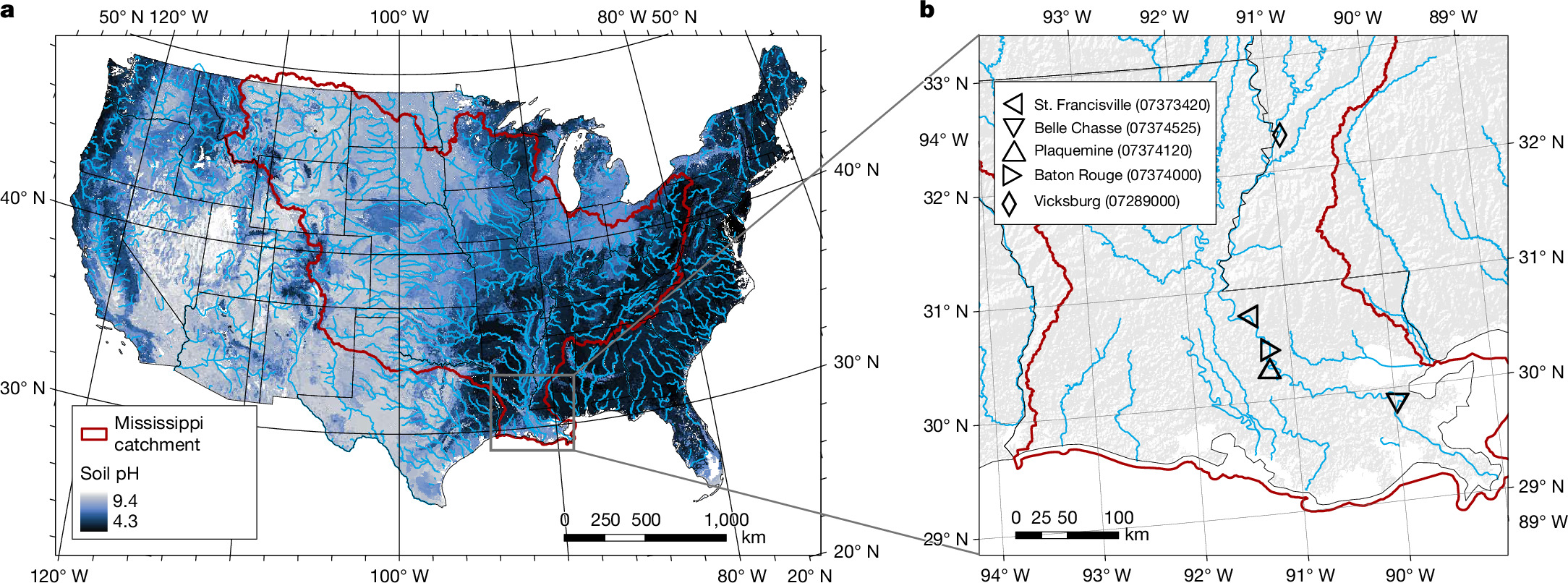
Abstract
Application of carbonate minerals to arable lands, known as agricultural liming, is a long-standing practice for counteracting soil acidification1,2,3. Although liming boosts crop yields4, it is also considered a source of agricultural carbon dioxide (CO2) emissions5. Here we show, using century-scale records of agricultural liming and anthropogenic acidity inputs for the Mississippi River Basin, that agricultural liming has acted as a net carbon sink over the past century. Records of river alkalinity fluxes suggest that approximately 90% of the ideal CO2 removal potential of agricultural lime added since 1900 (approximately 0.44 GtCO2) has been realized at the catchment scale, with a decadal-scale time lag owing to soil cation exchange and solute transport. These results are consistent with reactive transport modelling of soil cation throughput, which indicates that net CO2 removal emerges after an initial emissions pulse associated with neutralization of soil acidity pools. Current accounting frameworks implicitly apply an incomplete counterfactual, attributing CO2 emissions to lime addition rather than to the anthropogenic acidity inputs that drive CO2 release. Evaluated against the counterfactual of anthropogenic acidity inputs, agricultural liming represents a net carbon sink in the Mississippi River Basin on decade-to-century timescales. These results suggest that optimized soil pH management can reduce agricultural greenhouse gas emissions while simultaneously improving crop yields and soil health.

