2026-09-16 中国科学院(CAS)
<関連情報>
- https://english.cas.cn/newsroom/research-news/202609/t20260917_1200810.shtml
- https://link.springer.com/article/10.1007/s11104-026-09082-6
樹木の多様性と菌根菌の種類は、植林後10年間にわたって土壌断面全体における菌類の死骸量に、土壌炭素や窒素よりも大きな変化をもたらす Tree diversity and mycorrhizal type induce stronger shifts in fungal necromass than in soil carbon and nitrogen across the soil profile over a decade of afforestation
Tengteng Li (李腾腾), Olga Ferlian, Panpan Wu, Zhanfeng Liu (刘占锋) & Nico Eisenhauer
Plant and Soil Published:14 September 2026
DOI:https://doi.org/10.1007/s11104-026-09082-6
Abstract
Background and aims
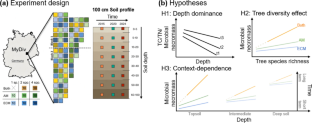
Tree species richness can enhance soil carbon (C) and nitrogen (N) storage, but such biodiversity effects are mediated by mycorrhizal associations and may vary with soil depth and stand age. How these effects emerge across the soil profile during early forest development remains poorly understood, particularly for microbial necromass.
Methods
We quantified soil total C (TC), total N (TN), and microbial necromass (amino sugar biomarkers) along a 1 m profile in a decade-old tree diversity experiment manipulating tree species richness (1, 2, and 4 species) and mycorrhizal type (arbuscular mycorrhizal (AM), ectomycorrhizal (ECM), and mixed AM + ECM (Both)).
Results
Over the first decade, TC, TN and microbial necromass declined by ca. 3%, 17% and 14% across the profile. Soil depth dominated overall variation, while temporal trajectories differed: TN declined first in the upper 40 cm (first five years) then extended deeper while recovering in topsoil; TC declined later at intermediate depths (5–40 cm); microbial necromass decreased later across the whole profile. Biodiversity effects were detected only for microbial necromass and varied with mycorrhizal type, depth, and time. Fungal necromass dominated total microbial necromass dynamics and showed the strongest biodiversity responses, increasing by 21–27% in topsoil in mixed AM + ECM communities initially and by ca. 24% in ECM communities after a decade.
Conclusion
Our findings reveal a depth- and time-dependent decoupling between microbial necromass dynamics and bulk soil C and N accumulation during afforestation, suggesting biodiversity effects emerge through fungal-mediated pathways before becoming detectable in bulk soil C pools.