2026-06-12 コロンビア大学
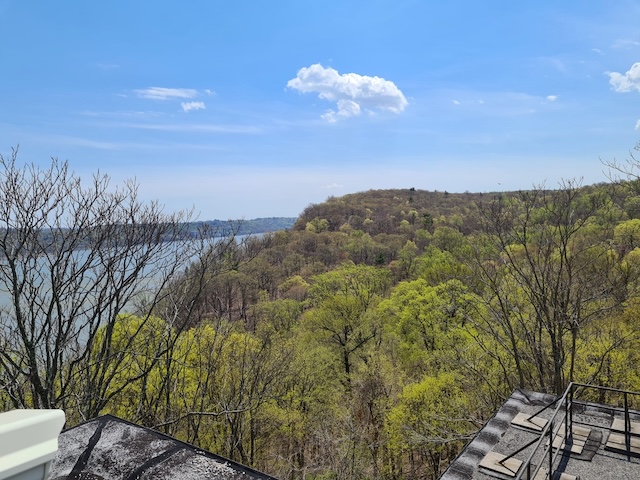
A photo from the top of the Oceanography building where the PhenoCam is located at Lamont-Doherty Earth Observatory. Credit: Mukund Rao
<関連情報>
- https://news.climate.columbia.edu/2026/06/12/new-research-indicates-that-in-the-future-trees-may-store-less-carbon-than-expected/
- https://www.science.org/doi/10.1126/sciadv.ady7139
温帯落葉性オークにおける乾燥に対する炭素同化と成長反応の分離 Decoupled carbon assimilation and growth responses to aridity in temperate deciduous oaks
Mukund Palat Rao, Arturo Pacheco-Solana, Rong Li, Bar Oryan, […] , and Troy S. Magney
Science Advances Published:12 Jun 2026
DOI:https://doi.org/10.1126/sciadv.ady7139
Abstract
The magnitude of the terrestrial carbon sink remains a key uncertainty in future climate projections, in part due to poorly understood links between carbon uptake and its allocation to woody biomass in vegetation. Here, in this study, we show that photosynthesis and aboveground growth occur asynchronously across diel to seasonal scales in eight North American oak species. Across 137 tree ring sites, current-year annual growth was insensitive to climate variability after midsummer despite 26 to 36% of annual gross primary productivity (GPP) occurring during this period. Hourly GPP flux and growth measurements at four sites spanning seven site years further demonstrate that wood formation ceases earlier than photosynthesis and is restricted to periods of low atmospheric aridity and temperature. This photosynthesis-growth decoupling intensifies with interannual variability in vapor pressure deficit (r = 0.86, P < 0.05), suggesting that by assuming tight coupling between photosynthesis and woody biomass, current earth system models may overestimate long-term carbon sequestration in forests.