2026-08-07 バーミンガム大学
<関連情報>
- https://www.birmingham.ac.uk/news/2026/spacecraft-observations-may-conceal-how-particles-really-move-through-near-earth-space-1
- https://journals.aps.org/prresearch/abstract/10.1103/5mmn-fm2p
衝突のない位相混合は、放射線帯観測における拡散輸送を模倣する Collisionless phase mixing mimics diffusive transport in radiation belt observations
Adnane Osmane, Xin An, Anton V. Artemyev, Oliver Allanson, Jay Albert, and Miroslav Hanzelka
Physical Review Research Published: 24 July, 2026
DOI: https://doi.org/10.1103/5mmn-fm2p
Abstract
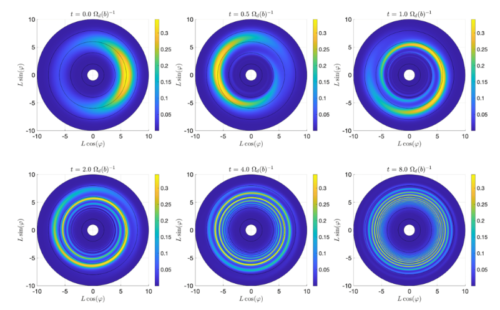
Since the dawn of the space age, observations of energetic particles in planetary radiation belts have been interpreted within a diffusive transport framework, even though the dominant processes that populate and deplete these belts—such as injections and moon-driven absorption—produce particle distributions that are highly structured and spatially localized. This exposes a fundamental question: How can coherent phase-space structures evolving under collisionless dynamics give rise to observational signatures that appear consistent with diffusion-based transport? Here, we show that diffusionlike behavior inferred from radiation belt observations can arise solely from an observational phase-mixing effect, independent of stochastic wave-particle transport. As orbiting spacecraft sweep across neighboring drift shells while trapped particles undergo electromagnetic drifts, measurements inevitably sample regions with slightly different drift frequencies. This converts spatially localized drift-phase structures into rapidly decorrelating temporal signals, making them observationally indistinguishable from those produced by stochastic wave-particle processes. We derive the associated correlation function analytically and show that the effective lifetime of these structures is only a few drift periods. Consequently, even highly localized injections rapidly lose coherence, preventing spacecraft from resolving fine-scale structure in the distribution function. These results show that collisionless dynamics can produce observational signatures that mimic diffusive transport on timescales shorter than those expected from radial transport, limiting the inference of particle acceleration processes and leading to biased transport rates and inaccurate long-term flux predictions. This calls for a reassessment of diffusion-based interpretations inferred from sparse in situ measurements of radiation belts at Earth, across the solar system, and in the recently discovered radiation belts of ultracool brown dwarfs.