
2026-08-03 スタンフォード大学
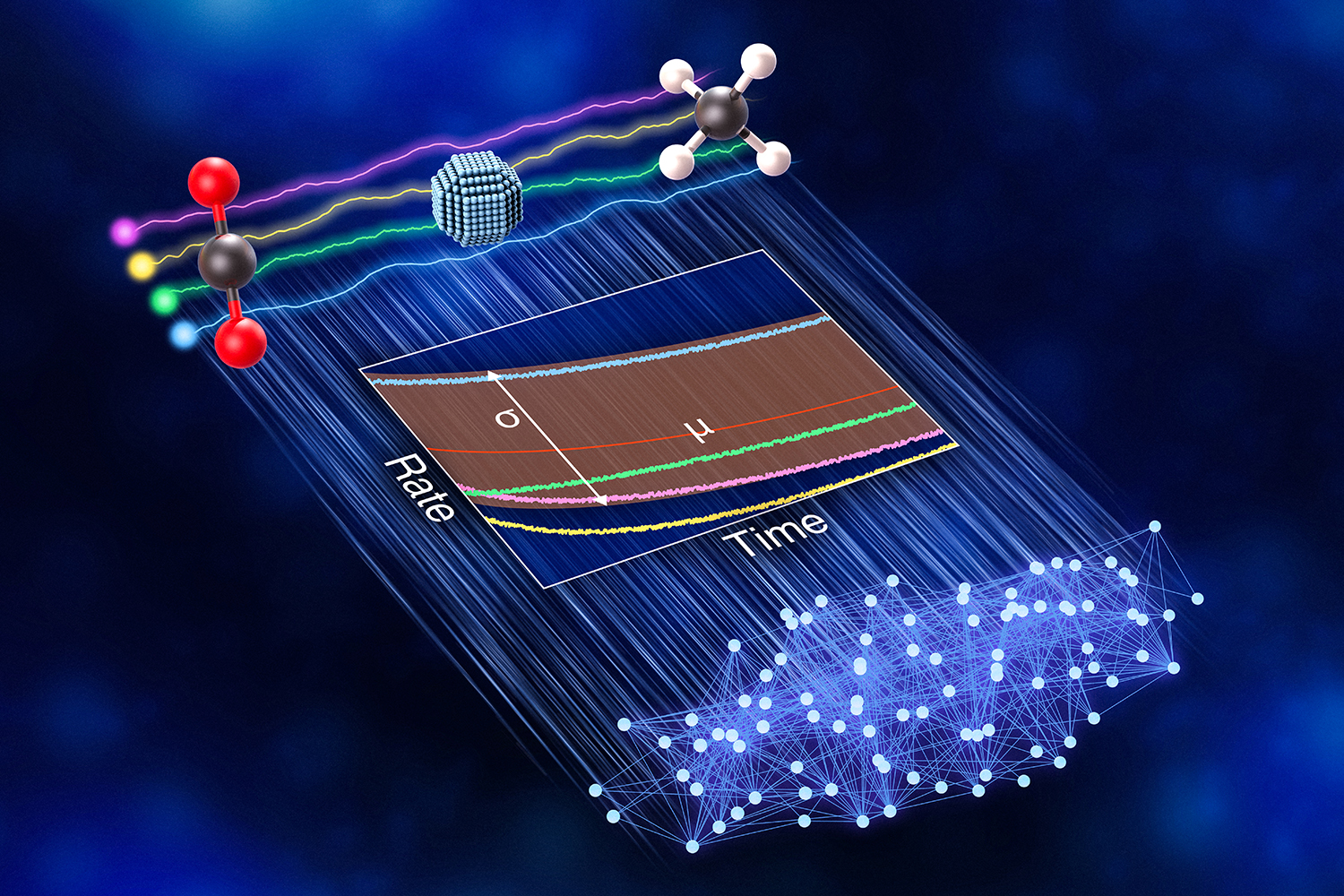
A study conducted at four laboratories across the country demonstrated how experimental protocol and equipment standardization govern result variability. Recognizing this variability is essential when incorporating real-world data into AI/machine learning models. | Adam Hoffman and Greg Stewart / SLAC National Accelerator Laboratory
<関連情報>
- https://news.stanford.edu/stories/2026/08/reproducibility-ai-driven-science
- https://www.nature.com/articles/s41929-026-01559-y
データ駆動型モデリングのためのラウンドロビン試験によるCO2水素化反応中の触媒活性および失活における不確実性の定量化 Quantifying uncertainty in catalyst activity and deactivation during CO2 hydrogenation via round-robin testing for data-driven modelling
Selin Bac,Dongjae Shin,Seunghwa Hong,Jake Heinlein,Anastassiya Khan,Greg Barber,Zhihengyu Chen,Michael M. Albrechtsen,Christopher Tassone,Robert M. Rioux,Matteo Cargnello,Simon R. Bare,Kirsten Winther,Phillip Christopher & Adam S. Hoffman
Nature Catalysis Published:31 July 2026
DOI:https://doi.org/10.1038/s41929-026-01559-y
Abstract
Machine learning (ML) is rapidly emerging as a catalyst discovery method, whose success depends on curated experimental datasets with defined uncertainties. Despite this need, uncertainty in catalyst performance is rarely quantified across datasets generated using multiple reactors. Here we present a four-laboratory round-robin study of Rh/TiO2 catalysts for CO2 hydrogenation that demonstrates that accounting for both intra- and interlaboratory variability is essential for identifying features for experimentally derived ML models. Even with identical catalyst batches and testing protocols, relationships between inputs (reaction temperature, Rh loading and synthesis method) and outputs (conversion, selectivity and CO and CH4 production rates) that were clear in intralaboratory studies became statistically insignificant when interlaboratory variability was included. Heat management emerged as a key contributor to this variability. Our work demonstrates that uncertainty analysis must be included in the selection of performance metrics and input features for ML models while revealing sources of variability that limit rigour and reproducibility.

