2026-03-05アメリカ合衆国・ローレンスバークレー国立研究所(LBNL)
<関連情報>
- https://newscenter.lbl.gov/2026/03/05/thermodynamic-computing-advances-with-design-and-training/
- https://www.nature.com/articles/s41467-025-67958-0
非線形熱力学計算による非平衡状態 Nonlinear thermodynamic computing out of equilibrium
Stephen Whitelam &Corneel Casert
Nature Communications Published:10 January 2026
DOI:https://doi.org/10.1038/s41467-025-67958-0


Abstract
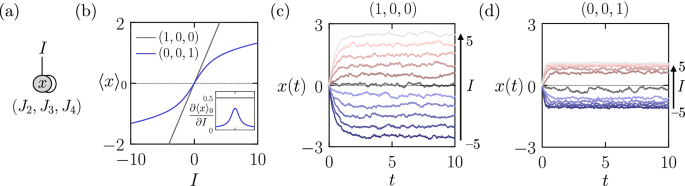
We present the design for a thermodynamic computer that can perform arbitrary nonlinear calculations in or out of equilibrium. Simple thermodynamic circuits, fluctuating degrees of freedom in contact with a thermal bath and confined by a quartic potential, display an activity that is a nonlinear function of their input. Such circuits can therefore be regarded as thermodynamic neurons, and can serve as the building blocks of networked structures that act as thermodynamic neural networks, universal function approximators whose operation is powered by thermal fluctuations. We simulate a digital model of a thermodynamic neural network, and show that its parameters can be adjusted by genetic algorithm to perform nonlinear calculations at specified observation times, regardless of whether the system has attained thermal equilibrium. This work expands the field of thermodynamic computing beyond the regime of thermal equilibrium, enabling fully nonlinear computations, analogous to those performed by classical neural networks, at specified observation times.