2026-08-21 東京科学大学
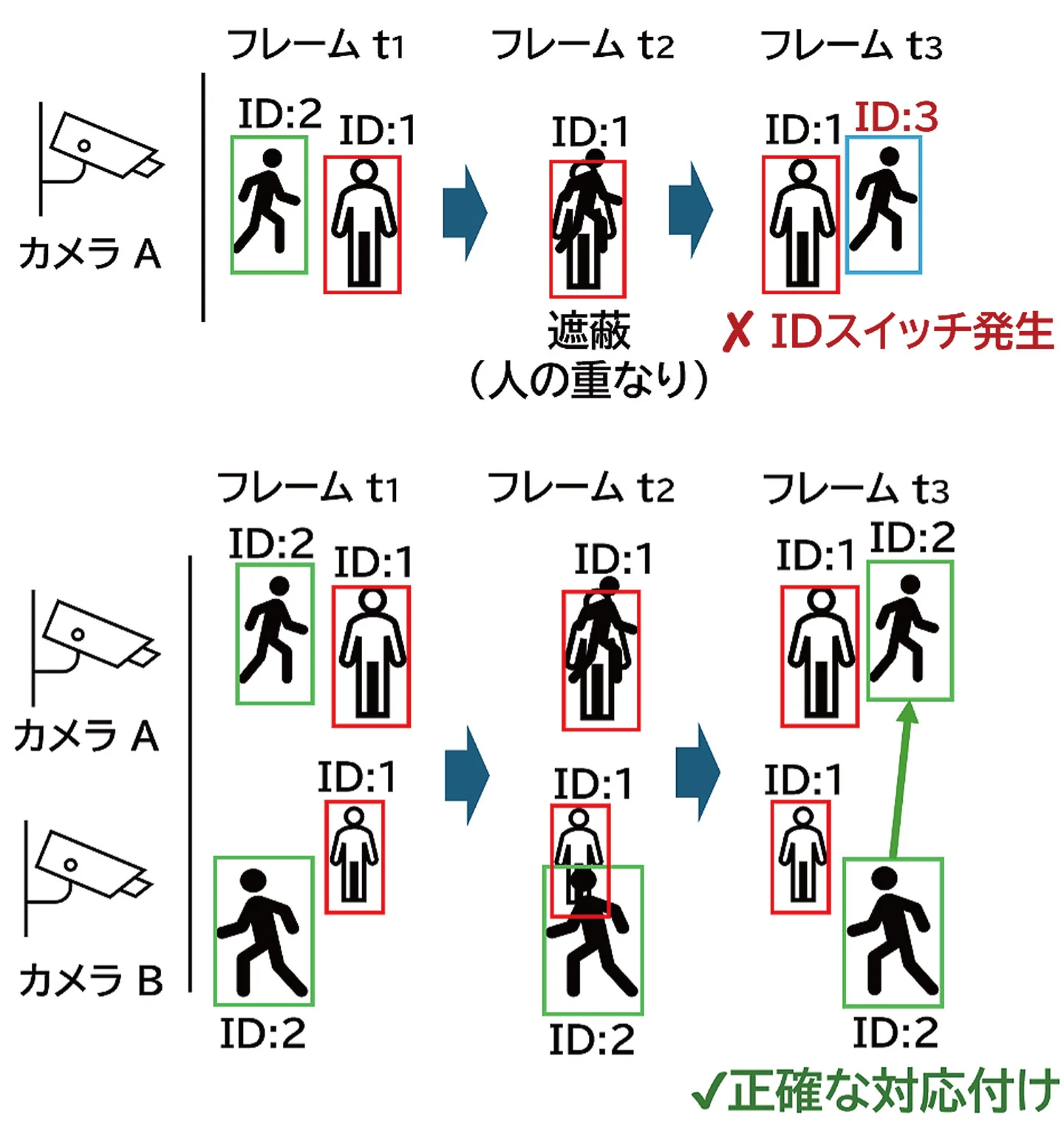
図1. 単一カメラと複数カメラによる人物追跡の違い
<関連情報>
- https://www.isct.ac.jp/ja/news/tuvane73jm2p
- https://link.springer.com/chapter/10.1007/978-3-032-31663-9_30
エピポーラ距離と外観類似性に基づくマルチカメラ・マルチオブジェクト追跡 Multi-camera Multi-object Tracking Based on Epipolar Distance and Appearance Similarity
Masamune Oka,Masayuki Tanaka,Takashi Shibata & Masatoshi Okutomi
Pattern Recognition Published:03 August 2026
DOI:https://doi.org/10.1007/978-3-032-31663-9_30
Abstract
Multi-camera multi-object tracking (MC-MOT) is key to accurately tracking people and objects in open and wide areas for video surveillance and traffic monitoring. Accurate MC-MOT requires robust association among the detected bounding boxes of different frames. In this paper, we propose multi-camera tracking framework that links each tracklet obtained from each single-camera tracking across overlapping fields of view by jointly exploiting geometry and appearance cues simultaneously. In the tracklet association of the proposed framework, we evaluate two complementary similarity scores for every cross-view pair: i) an epipolar distance evaluated by epipolar geometry between each camera pair, ii) an appearance-based similarity obtained using image features of each target image patch. These similarities drive an efficient one-to-one association scheme that can preserve identities even under severe occlusion in a single view, without requiring specialized hardware or heavy-model retraining for association. Extensive experiments on the MMPTrack and CAMPUS benchmark show that the proposed framework can reduce ID switches and improves overall tracking accuracy compared with both single-camera baselines and recent multi-camera trackers. The sanitized MMPTrack dataset and the code for reproduction are publicly available at: http://www.ok.sc.e.titech.ac.jp/res/MOT/.