2026-10-12 中国科学院(CAS)
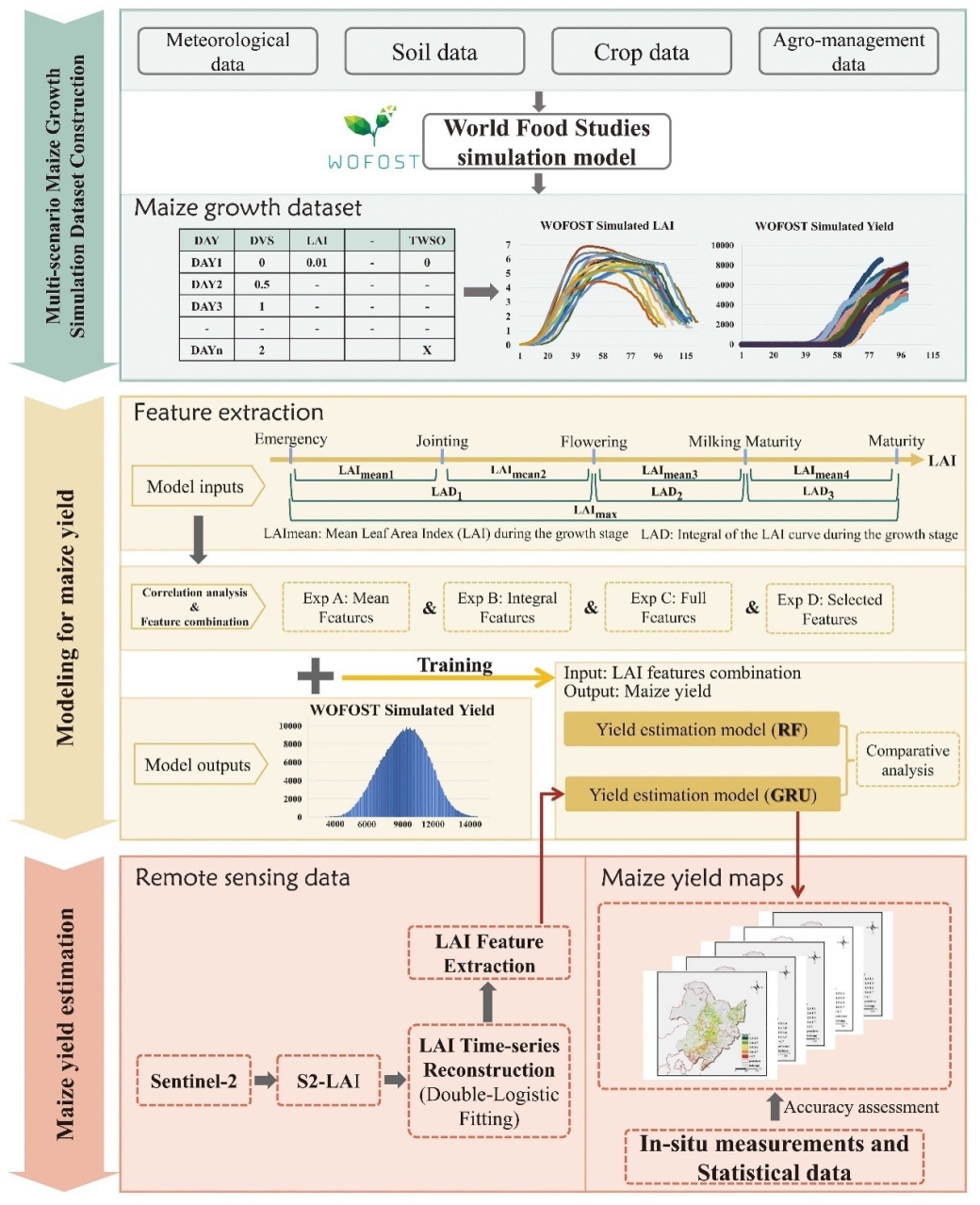
Maize yield estimation framework for Northeast China. (Image by AIRCAS)
<関連情報>
- https://english.cas.cn/newsroom/research-news/202610/t20261012_1202280.shtml
- https://essd.copernicus.org/articles/18/6065/2026/
NortheastChinaMaizeYield10m:メカニズム的に解釈可能で、現地ラベルを必要としないフレームワークを用いて生成された、中国東北部のトウモロコシ収量データセット(2019年~2024年、10m解像度) NortheastChinaMaizeYield10m: a 10 m resolution maize yield dataset for Northeast China (2019–2024) generated via a mechanistically interpretable, field-label-free framework
Jingbo Hu, Xin Du, Qiangzi Li, Yuan Zhang, Hongyan Wang, Jiansong Luo, Jingyuan Xu, Yachao Zhao, Zhaoming Zhang, Yong Dong, and Yunqi Shen
Earth System Science Data Published:25 Aug 2026
DOI:https://doi.org/10.5194/essd-18-6065-2026
Abstract
In the face of escalating global food demand and increasing climate variability, precise and granular crop yield monitoring is indispensable for maintaining regional agricultural stability. However, current deep learning approaches for yield estimation are severely constrained by their heavy reliance on massive in situ labeled data, which limits their application in data-scarce regions. Furthermore, these models often overlook the essential temporal evolution logic of yield formation and lack a systematic discussion regarding the contribution patterns of different feature dimensions, resulting in a black-box nature of the underlying model mechanisms. To address these challenges, this study proposes a field-label-free training framework for maize yield estimation that couples mechanistic model with deep learning. The framework’s core strength lies in a physiologically complete simulation database, using the WOFOST model to exhaustively cover 30 years of climate variability and habitat combinations across Northeast China (1.24 × 10⁶ km2). A Gated Recurrent Unit (GRU) network was then introduced for end-to-end modeling, accurately capturing the energy accumulation trajectory from vegetative to reproductive growth. Validation against 458 independent ground points (2022–2024) demonstrated robust generalization with an R2 of 0.69, an RMSE of 1.21 t ha−1, and an RRMSE of 13.73 %, despite using no ground data for training. Our analysis revealed that integrating photosynthetic intensity (LAImean), duration (LAD) and peak features (LAImax) across growth stages is critical for accuracy, while omitting early-stage features significantly impairs the model’s ability to capture cumulative growth effects. Furthermore, the model successfully captured the spatiotemporal yield anomalies caused by the 2023 typhoon and flooding events. Ultimately, this study generated a 10 m resolution maize yield dataset (2019–2024) for Northeast China. The dataset exhibits consistent interannual stability, with the RRMSE ranging from 7.98 % to 12.92 % and the R2 remaining above 0.44 at the city level. By deeply coupling mechanistic simulation with data mining, this dataset provides detailed support for optimizing agricultural production and guiding farming practices. The Northeast China Maize Yield 10 m dataset is openly available at https://doi.org/10.5281/zenodo.19547014 (Hu et al., 2026).