2026-01-22 中国科学院(CAS)
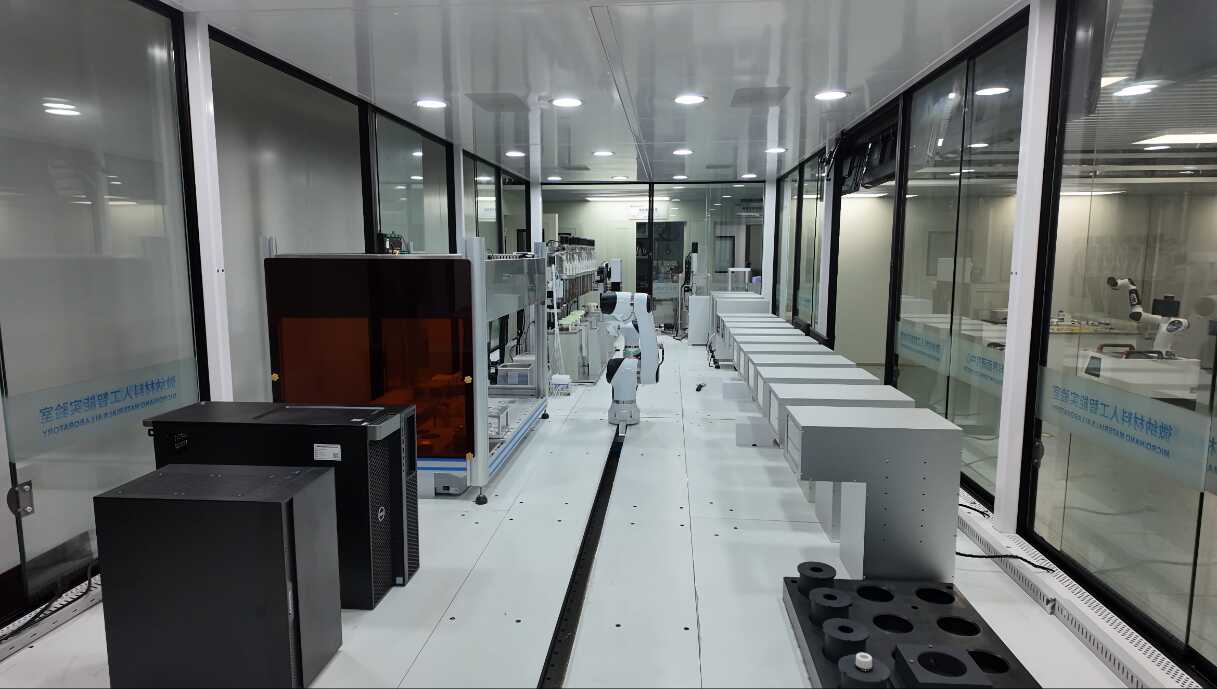
Knowledge-driven multi-agent and robot system. (Image by SIAT)
<関連情報>
- https://english.cas.cn/newsroom/research_news/tech/202601/t20260123_1146513.shtml
- https://www.sciencedirect.com/science/article/abs/pii/S2590238525006204
協調型マルチエージェントおよびロボットシステムによる知識駆動型自律材料研究 Knowledge-driven autonomous materials research via collaborative multi-agent and robotic system
Tongyu Shi, Yutang Li, Zhanlong Wang, Wenhe Xu, Guolai Jiang, Dawei Dai, Jie Zhou, Hao Huang, Rui He, Seeram Ramakrishna, Paul K. Chu, Wenhua Zhou, Xue-Feng Yu
Matter Available online: 21 January 2026
DOI:https://doi.org/10.1016/j.matt.2025.102577
Highlights
- Hierarchical multi-agent system with specialized tools mimics human research teams
- LLM-robot integration drives end-to-end autonomous materials research
- Hybrid retrieval enables cross-domain knowledge integration for professional designs
- Knowledge-based reasoning across domains leads to materials design
Progress and potential
Large language models (LLMs) provide new possibilities for accelerating materials research, yet their application in complex materials science remains limited. Here, we developed the collaborative multi-agent and robot system (MARS), a knowledge-driven hierarchical architecture coordinating 19 LLM agents with 16 domain-specific tools organized into functional modules, achieving closed-loop autonomous materials discovery by integrating robotic experimentation. MARS offers accurate and professional guidance for materials development and relieves the hallucination inherent to current LLMs through a hybrid retrieval-augmented generation approach. As experimental validation, the system demonstrates its capabilities in perovskite nanocrystal development, optimizing synthesis protocols within 10 experimental iterations and designing a biomimetic “core-shell-corona” structure for water-stable perovskite composites within 3.5 h compared to conventional methods requiring 4–6 months. Through an interactive natural language interface, researchers can orchestrate experiments while tracking real-time agent coordination.
Beyond efficiency gains, MARS represents a paradigm shift toward truly autonomous materials research where knowledge-driven AI can initiate scientific discovery. MARS can combine knowledge from different scientific fields to create solutions that human researchers might overlook, as demonstrated by its biomimetic design inspired by cell membranes. Looking forward, we envision MARS accelerating discoveries across critical areas including renewable energy materials, medical compounds, and sustainable technologies. This could help address urgent global challenges like climate change and healthcare needs by removing research bottlenecks. As the system evolves, it could democratize advanced materials research by reducing dependence on specialized infrastructure and expertise, allowing scientists worldwide to focus on creative problem-solving rather than repetitive tasks. MARS represents not just an improvement in research efficiency but also a fundamental shift in how we approach materials innovation.
Summary
Large language models (LLMs) provide new possibilities for accelerating materials research, yet their application in complex materials science remains limited. Here, we developed the collaborative multi-agent and robot system (MARS), a knowledge-driven hierarchical architecture coordinating 19 LLM agents with 16 domain-specific tools for closed-loop autonomous materials discovery. MARS combines scientific knowledge with decision-making capabilities while mitigating hallucination through retrieval-augmented generation with a customized knowledge base. In experimental validation, the system optimized perovskite nanocrystal synthesis within 10 iterations and designed a biomimetic “core-shell-corona” structure for water-stable perovskite composites in 3.5 h versus conventional methods requiring 4–6 months. This acceleration automates literature review and experimental planning, allowing researchers to focus on creative thinking while interacting through a natural language interface. This work establishes an integrated AI-driven framework for accelerating materials innovation and presents a paradigm for AI-enabled scientific discovery.