2026-07-21 東京科学大学
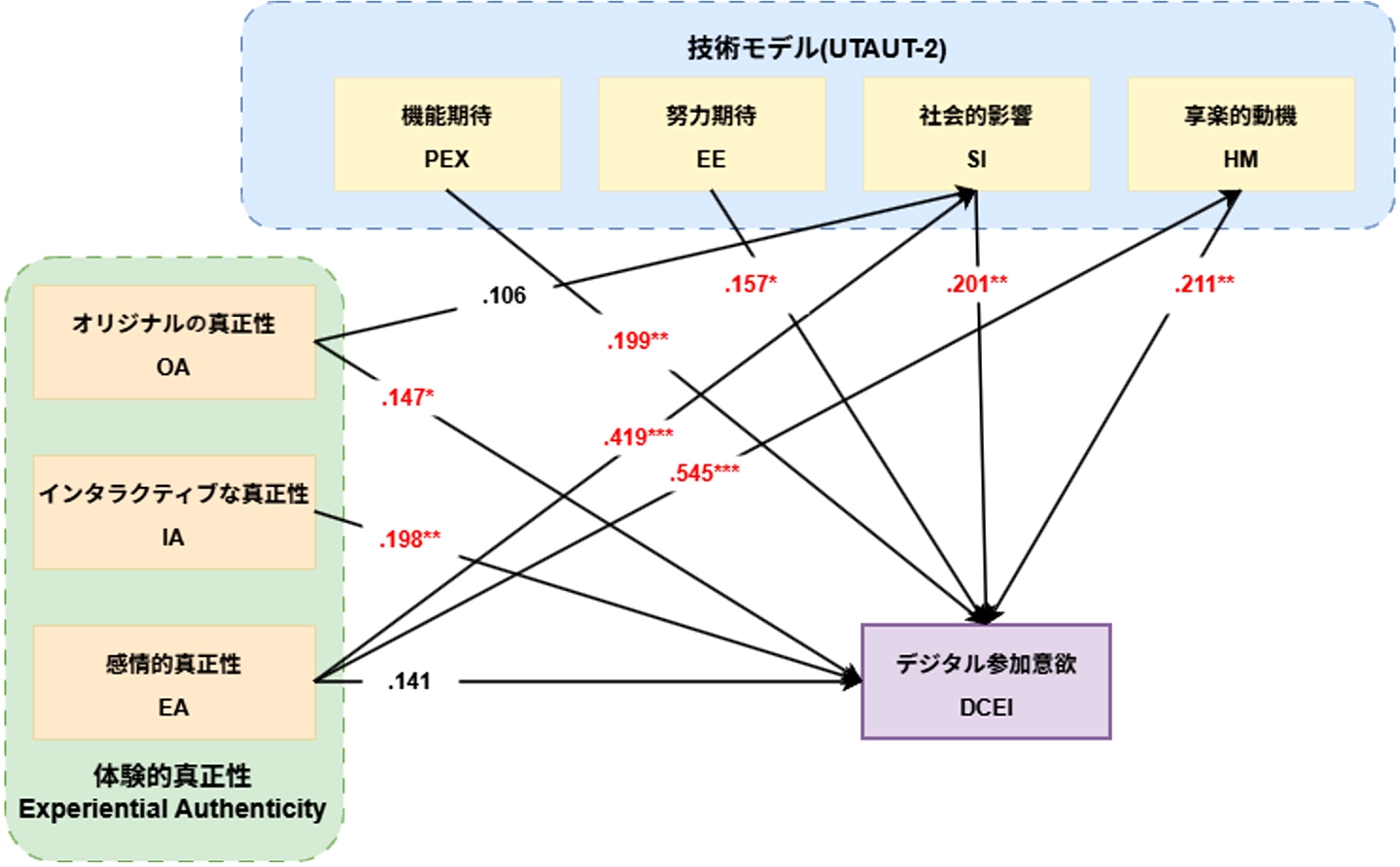
図2. SEM分析の結果
図中の数値はSEMによるパス係数であり、数値が大きいほど要素間の影響が強いことを示している。赤色の数値は統計的に有意な関係を、黒色の数値は統計的に有意ではない関係を示している。 ***p<.001、**p<.01、*p<.05
<関連情報>
UTAUT2と体験的真正性を統合した地域博物館におけるデジタル文化活動の理解:ハイブリッドSEM-ANNアプローチ Understanding Digital Cultural Engagement in Regional Museums by Integrating UTAUT2 and Experiential Authenticity: A Hybrid SEM-ANN Approach
Yaotian Ai, Xinru Zhu, Kayoko Nohara
ACM Journal on Computing and Cultural Heritage Accepted on 18 April 2026
DOI:https://doi.org/10.1145/3811917
Abstract
This study investigates the key determinants of digital cultural engagement in regional museums, with a specific focus on the relationship between technology acceptance models and museum authenticity experiences. This research operates within the context of accelerated museum digitization process precipitated by the COVID-19 pandemic, while acknowledging the distinctive connections between regional museums and local communities that require a reimagined approach to digital engagement. Using a co-design project for digital exhibitions at the Ryushi Memorial Museum in Ota City, Tokyo as a case study, this research uses a hybrid analytical methodology combining Structural Equation Modeling (SEM) and Artificial Neural Network (ANN) analysis. Data were collected through questionnaire surveys from 266 respondents (67 offline, 199 online). This study examines seven predictor factors: four UTAUT2 constructs (Performance Expectancy, Effort Expectancy, Social Influence, and Hedonic Motivation) and three authenticity dimensions (Original Authenticity, Interactive Authenticity, and Emotional Authenticity) to examine how these factors influence Digital Cultural Engagement Intention. SEM analysis revealed that all four UTAUT2 factors, as well as Original Authenticity and Interactive Authenticity, had significant direct effects on Digital Cultural Engagement Intention, with Hedonic Motivation (0.211) and Social Influence (0.201) demonstrating the strongest impact. While Emotional Authenticity did not exhibit a significant direct effect in the SEM model, it exerted substantial indirect effects through Hedonic Motivation and Social Influence. ANN analysis identified Emotional Authenticity as the most important predictor variable (0.218). This research makes a novel theoretical contribution by demonstrating that Emotional Authenticity functions as a ’meta-factor’ that influences digital engagement through complex indirect pathways rather than direct effects. For practitioners, the findings suggest that regional museums should prioritize emotional connections and community identity in their digital strategies rather than focusing on technical functionality.