2026-06-26 スタンフォード大学
<関連情報>
- https://news.stanford.edu/stories/2026/06/ai-engineering-burger-design-health-environment
- https://www.nature.com/articles/s41538-026-00953-x
- https://www.sciencedirect.com/science/article/pii/S0045782526004445
生成型人工知能が美味しく、持続可能で、栄養価の高いハンバーガーを生み出す Generative artificial intelligence creates delicious, sustainable, and nutritious burgers
Vahidullah Tac,Christopher D. Gardner & Ellen Kuhl
npj Science of Food Published:26 June 2026
DOI:https://doi.org/10.1038/s41538-026-00953-x
Abstract
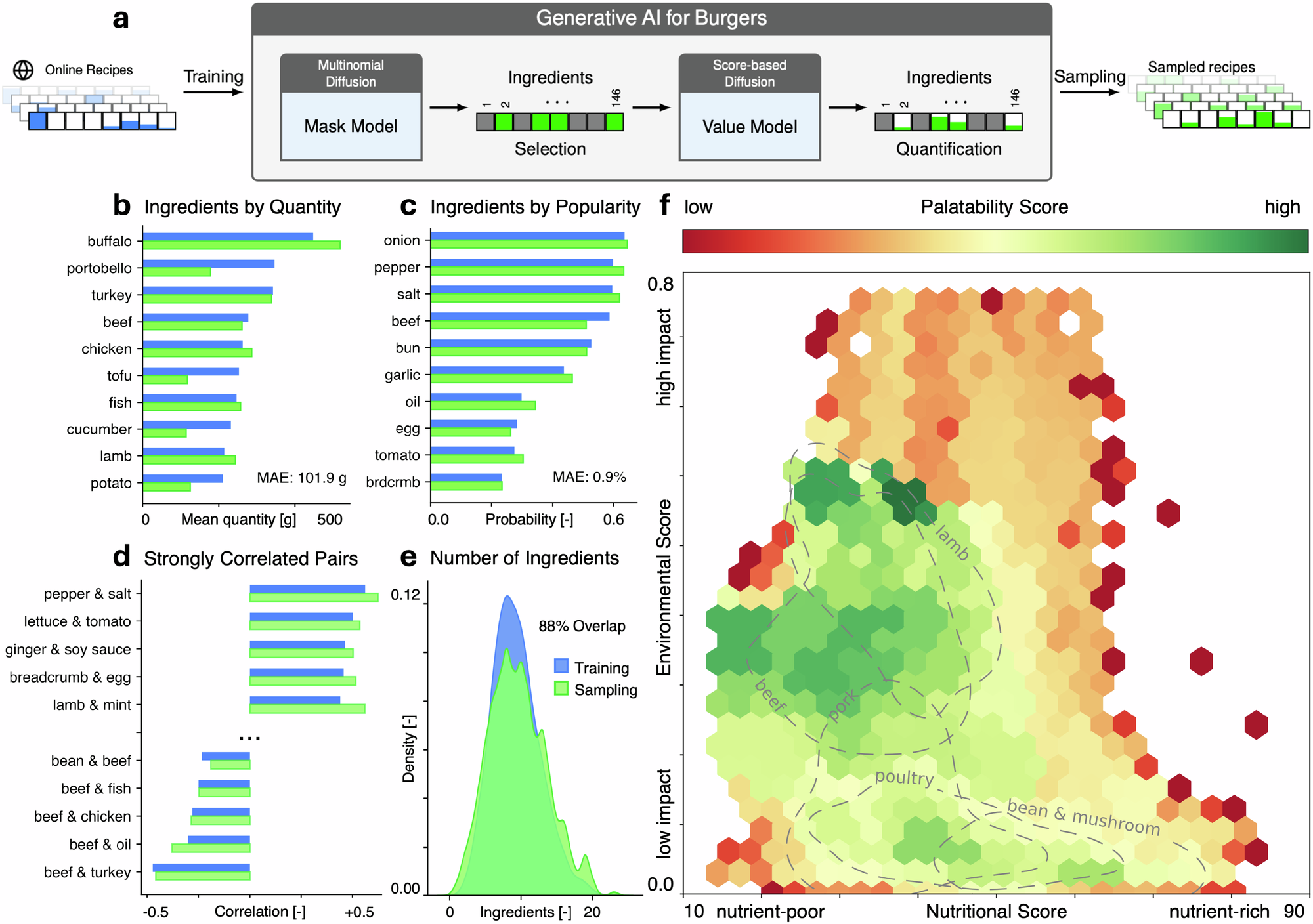
Food choices shape both human and planetary health; yet, designing foods that are delicious, nutritious, and sustainable remains challenging. Here we show that generative artificial intelligence can learn the structure of the human palate directly from large-scale, human-generated recipe data to create novel foods within a structured design space. Using burgers as a model system, the generative AI rediscovers the classic Big Mac without explicit supervision and generates novel burgers optimized for deliciousness, sustainability, or nutrition. Compared to the Big Mac, its delicious burgers score the same or better in overall liking, flavor, and texture in a blinded sensory evaluation conducted in a restaurant setting with 101 participants; its mushroom burger achieves an environmental impact score more than an order of magnitude lower; and its bean burger attains nearly twice the nutritional score. Together, these results establish generative AI as a quantitative framework for learning human taste and navigating complex trade-offs in principled food design.
材料設計のための生成AI:ハンバーガーから物質まで、力学的な視点から Generative AI for material design: A mechanics perspective from burgers to matter
Vahidullah Tac, Ellen Kuhl
Computer Methods in Applied Mechanics and Engineering Available online: 19 June 2026
DOI:https://doi.org/10.1016/j.cma.2026.119171
Abstract
Generative artificial intelligence offers a new paradigm to design matter in high-dimensional spaces. However, its underlying mechanisms remain difficult to interpret and limit adoption in computational mechanics. This gap is striking because its core tools – diffusion, stochastic differential equations, and inverse problems – are fundamental to the mechanics of materials. Here we show that diffusion-based generative AI and computational mechanics are rooted in the same principles. We illustrate this connection using a three-ingredient burger as a minimal benchmark for material design in a low-dimensional space, where both forward and reverse diffusion admit analytical solutions: Markov chains with Bayesian inversion in the discrete case and the Ornstein–Uhlenbeck process with score-based reversal in the continuous case. In both cases, forward diffusion adds noise to degrade structure, while reverse diffusion recovers structure from noise. We extend this framework to a high-dimensional design space with 146 ingredients and 8.9 possible configurations, where analytical solutions become intractable. We therefore learn the discrete and continuous reverse processes using neural network models that infer inverse dynamics from data. We train the models on only 2260 recipes and generate one million samples that capture the statistical structure of the data, including ingredient prevalence and quantitative composition. We further generate five new burgers and validate them in a blinded restaurant-based sensory study with n = 101 participants, where three of the AI-designed burgers outperform the classical Big Mac in overall liking, flavor, and texture. These results establish diffusion-based generative modeling as a physically grounded approach to design in high-dimensional spaces. They position generative AI as a natural extension of computational mechanics, with applications from burgers to matter, and establish a path towards data-driven, physics-informed generative design. Our source code, data, and examples are available at https://github.com/LivingMatterLab/AI4Food.