2026-07-01 中国科学院(CAS)
<関連情報>
- https://english.cas.cn/newsroom/cas-in-media/202607/t20260701_1175163.shtml
- https://www.nature.com/articles/s41550-026-02899-2
中心にあるコンパクト天体からのパルス状電波放射 Pulsed radio emission from a central compact object
Lei Zhang 张蕾,Alessandro Ridolfi,Di Li 李 菂,Erbil Gügercinoğlu,Fernando Camilo,Wynn C. G. Ho,Matthew Bailes,Ping Zhou 周 平,Craig O. Heinke & Marcus E. Lower
Nature Astronomy Published:25 June 2026
DOI:https://doi.org/10.1038/s41550-026-02899-2
Abstract
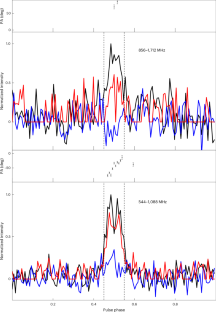
Located at the centres of supernova remnants, central compact objects (CCOs) are among the most puzzling neutron stars. CCOs are bright in thermal X-rays, yet have evaded detection by major radio telescopes for decades, giving rise to the view that they are intrinsically radio-quiet and possess exceptionally weak magnetic fields. Here we show that the prototypical young CCO 1E 1207.4–5209 is in fact a faint radio pulsar rotating at the 0.4-s X-ray period. Analysis of its polarization indicates that the radio beam intersects our line of sight near the magnetic pole, affirming that its radio faintness is intrinsic. Once its supernova remnant dissipates, this source would be misidentified as an apparently gigayear-old pulsar. The CCO’s low radio flux density may explain why many supernova remnants lack detectable radio pulsars and suggests a hidden population of young, slowly rotating neutron stars.