2026-06-11 中国科学院(CAS)
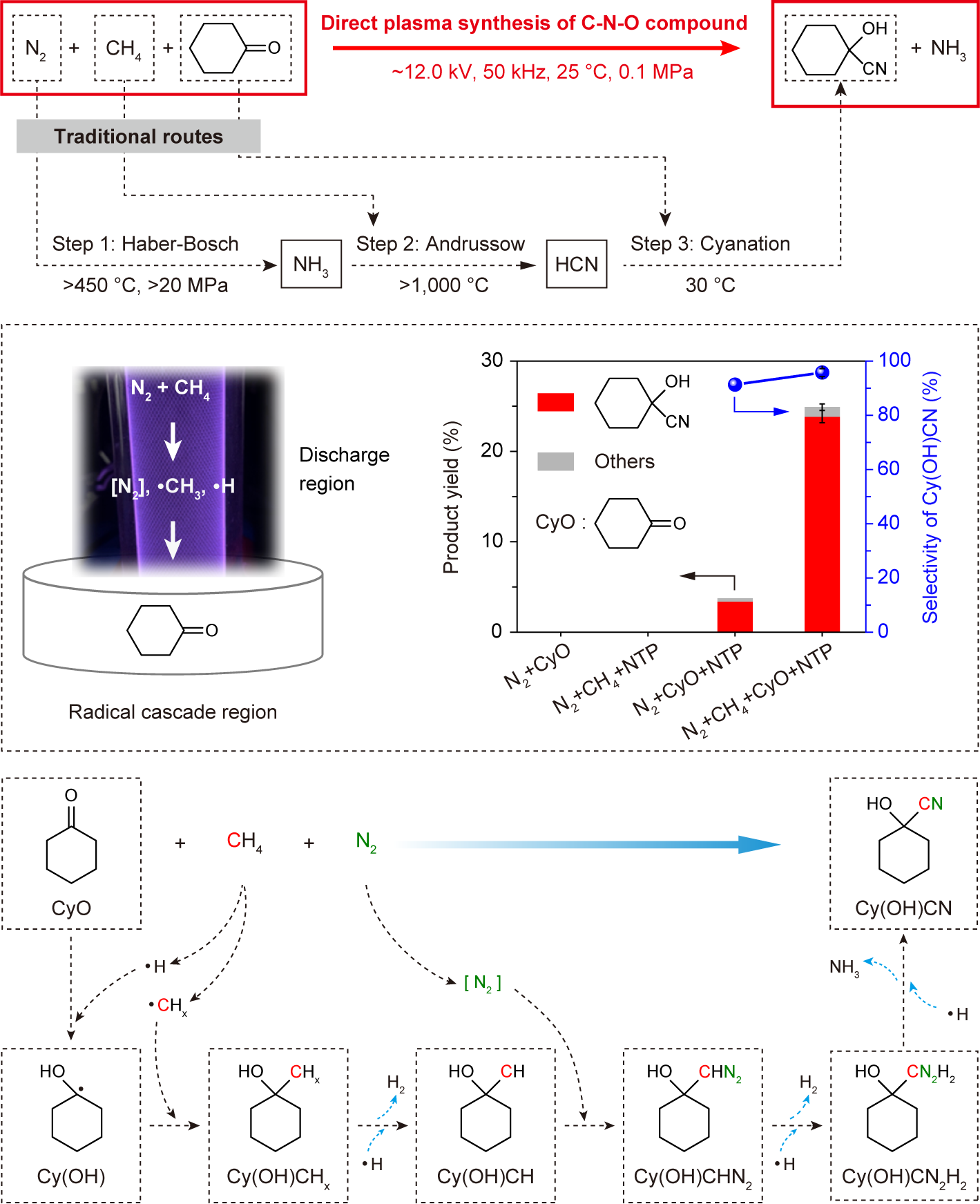
Schematic illustration of the performance and radical relay mechanism for the reaction of cyclohexanone and non-thermal plasma-activated nitrogen and methane. (Image by ZHANG Hao)
<関連情報>
- https://english.cas.cn/newsroom/research-news/202606/t20260611_1161572.shtml
- https://www.nature.com/articles/s44160-026-01055-y
不活性N₂およびCH₄を用いた高付加価値C–N–O化合物の直接プラズマ合成 Direct plasma synthesis of a high-value C–N–O compound with inert N2 and CH4
Hao Zhang,Ziming Liu,Di Li,Chenxin Wu,Lei Hua,Haiyang Li,Yanhui Yi,Rui Huang,Liang Yu & Dehui Deng
Nature Synthesis Published:21 April 2026
DOI:https://doi.org/10.1038/s44160-026-01055-y
Abstract
Direct co-conversion of earth-abundant N2 and CH4 to high-value C–N–O compounds is a promising synthetic method but remains challenging, as the activation of N2 and CH4 typically requires high-energy conditions that can cause product decomposition. Here we report a plasma-cascade process for synthesizing cyclohexanone cyanohydrin (Cy(OH)CN) via direct coupling of N2 and CH4 plasma with cyclohexanone. This catalyst-free process achieves a Cy(OH)CN formation rate of 0.60 mmol h−1 with a high selectivity of 95.8% towards the cyclohexanone-derived products under mild conditions, concurrently generating ammonia as a valuable coproduct. Comprehensive mechanistic studies reveal that plasma-generated ·CHx and hydrogen radicals enable direct α-carbonyl functionalization of cyclohexanone to α-CHx cyclohexanol intermediates, which then coupled mainly with excited-state N2 and are further activated by hydrogen radicals to generate Cy(OH)CN. This plasma-cascade strategy decouples the activation of inert molecules from the formation of relatively unstable C–N–O compounds, enabling selective cyanohydrin synthesis that avoids using high-cost NH3 and toxic HCN.