2026-08-12 中国科学院(CAS)
<関連情報>
- https://english.cas.cn/newsroom/research-news/202608/t20260812_1187850.shtml
- https://iopscience.iop.org/article/10.3847/1538-4357/ae876e
軌道進化解析に基づく地球近傍小惑星ペア候補の探索 Search for Near-Earth Asteroid Pair Candidates Based on Orbital Evolution Analysis
Ning Liu, JianChun Shi, Man-To Hui, Xian Shi, Sheng Jin, and Xiaoping LU
The Astrophysical Journal Published: 2026 August 5
DOI:10.3847/1538-4357/ae876e
Abstract
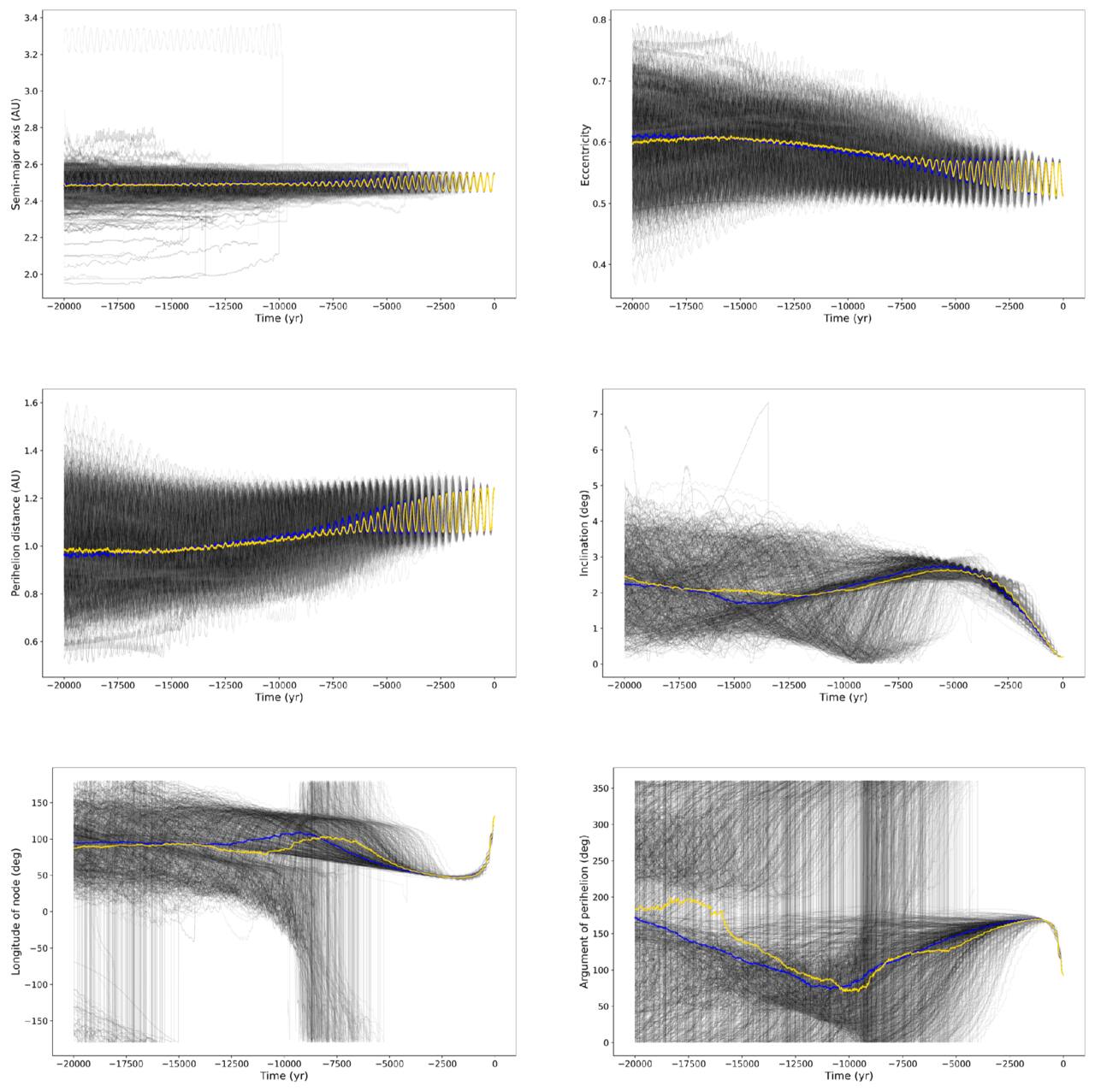
Asteroid pairs refer to pairs of bodies that exhibit a high degree of similarity in orbital element space but are not gravitationally bound dynamically. Compared with main-belt asteroids, the number of confirmed Near-Earth asteroid (NEA) pairs remains limited. This study aims to identify new candidate NEA pairs using dynamical evolution methods. We first apply the orbital similarity criterion DSH for preliminary screening, followed by numerical simulations to trace back their orbital evolution histories and determine potential separation epochs. The results indicate that 2012 QG8 and 2024 GE1, as well as 2022 MY3 and 2022 OP8, may constitute two young asteroid pairs formed within the past 1000 yr, whereas the separation time of 2019 SK10 and 2012 SN 30 can be traced back to approximately 16 kyr ago. In addition, 2010 VU198 and 2025 AW2 also exhibit significant correlations and are worthy of further investigation.