2026-06-09 東北大学
◆研究では、アセチレン(C₂H₂)がCeO₂表面で113℃から分解を開始し、その際に形成される酸素空孔が炭素種の活性化とグラフェン形成を促進することを発見した。さらに反応温度を制御することで、グラフェン量子ドット、凝集グラフェン、多孔性グラフェンなど異なる構造のグラフェン系材料を選択的に合成できることを示した。これらの材料は電池電極、触媒担体、吸着材、スーパーキャパシタ、発光材料などへの応用が期待される。
◆本成果は、未利用・余剰炭化水素ガスや有機資源を高付加価値のカーボン材料へ転換する低温炭素化プロセスの新たな設計指針を提供するものであり、資源循環型社会に向けた高機能炭素材料製造技術の発展に貢献すると期待される。
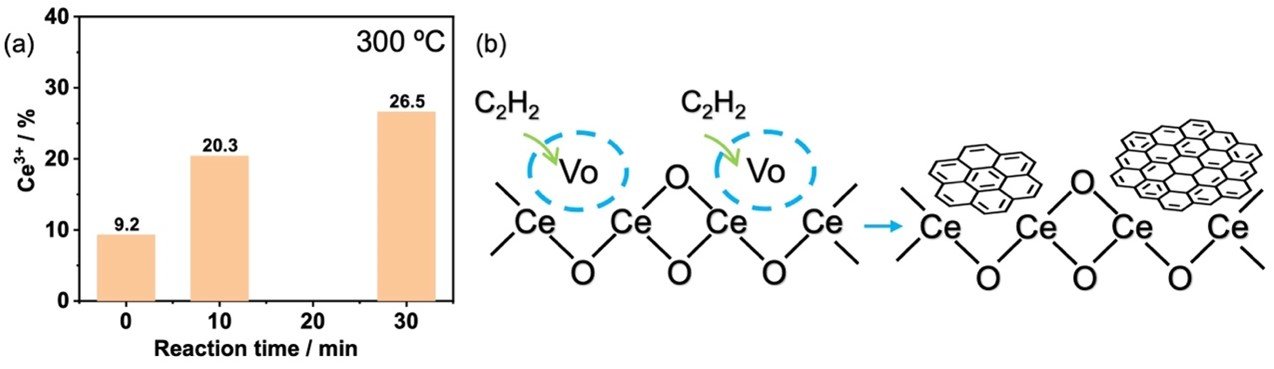
図1. (a)300℃におけるCVDに伴うCe³⁺割合の増加。(b)酸素空孔を介したアセチレンからのグラフェン形成の模式図。
<関連情報>
- https://www.tohoku.ac.jp/japanese/2026/06/press20260609-01-acetylene.html
- https://pubs.acs.org/doi/10.1021/jacs.5c20150
欠陥を介した触媒作用による低温でのグラフェン系材料の形成 Defect-Mediated Catalysis for Low-Temperature Formation of Graphene-Based Materials
Mengxuan Zhang,Takeharu Yoshii,Qi Zhao,Yuichiro Hayasaka,Devis Di Tommaso,and Hirotomo Nishihara
Journal of the American Chemical Society Published: June 8, 2026
DOI:https://doi.org/10.1021/jacs.5c20150
Abstract
Achieving low-temperature graphene formation remains a major challenge in carbon materials chemistry. Here we reveal a defect-mediated catalytic mechanism in which dynamically generated oxygen vacancies on ceria (CeO2) activate acetylene (C2H2) and direct the structural evolution of carbon networks at remarkably low temperatures. The oxygen-vacancy–driven redox dynamics of CeO2 enables C2H2 decomposition to proceed at temperatures as low as 113 °C, initiating carbon nucleation and leading to graphene domain formation below 300 °C. The temperature-dependent evolution─from graphene quantum dots (GQDs, 300 °C) to aggregated graphene (450 °C) and porous graphene frameworks (600 °C)─illustrates a designable transition in carbon connectivity directed by defect chemistry. Mechanistic studies combining in situ spectroscopy, thermogravimetry, and density functional theory reveal that the reaction follows a temperature-dependent transition from a radical to a carbene pathway, governed by the oxygen-vacancy chemistry of CeO2. Together, these results define a defect-mediated catalytic paradigm that couples oxide redox dynamics with carbon dimensionality control, offering a general principle for low-temperature formation of graphene-based sp2 carbon materials.