2026-07-14 カリフォルニア大学ロサンゼルス校(UCLA)
Younghee Lee at CUBE3D Graphic
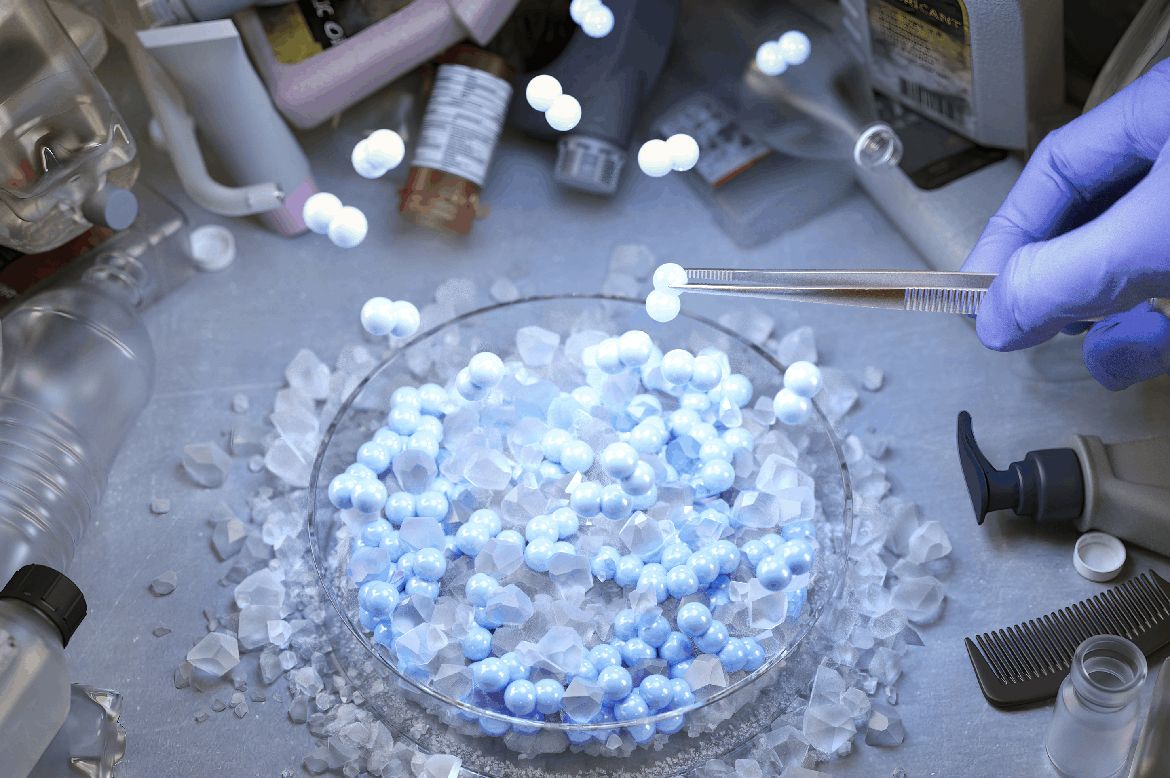
An illustration of a thermal treatment process that transforms heterogeneous plastic waste into a biomass-like hydrogen source, enabling hydrogen production without carbon dioxide emissions.
<関連情報>
- https://newsroom.ucla.edu/releases/new-process-turns-mixed-plastic-waste-hydrogen-fuel-without-sorting
- https://www.pnas.org/doi/10.1073/pnas.2537552123
- https://www.nature.com/articles/s41467-020-17627-1
混合プラスチック廃棄物からの選択的かつ直接的な水素生成(固有の炭素貯蔵を伴うアルカリ熱処理による) Selective and direct hydrogen generation from mixed plastic waste via alkaline thermal treatment with inherent carbon storage
Jieun Park, Hyunah Kim, Hyerin Seo, +4 , and Woo-Jae Kim
Proceedings of the National Academy of Sciences Published:July 6, 2026
DOI:https://doi.org/10.1073/pnas.2537552123
Abstract
The global accumulation of plastic waste has spurred extensive research into chemical recycling methods to mitigate environmental issues and convert waste into valuable resources. A major challenge in plastic recycling is the requirement for presorting, which complicates processing and increases costs. Here, we demonstrate alkaline thermal treatment (ATT) as a highly efficient strategy for directly converting mixed plastic waste, including polyethylene terephthalate (PET), polyethylene (PE), and polypropylene (PP), into clean hydrogen energy at low temperatures and atmospheric pressure. Unlike conventional gasification, NaOH-assisted ATT enables plastic decomposition at significantly lower temperatures while producing high-purity hydrogen and minimizing carbon emissions. A key advancement in this work is the oxidation pretreatment of PP and PE, which enhances their reactivity in ATT and allows efficient hydrogen generation even from typically resistant polyolefins. Through systematic optimization of the NaOH-to-plastic ratio and thermal oxidation conditions, hydrogen yields of 43.7, 51.9, and 30.2 mmol/gplastic were achieved for PET, PE, and PP, respectively. Furthermore, ATT efficiently converts both individual and mixed plastic waste without requiring extensive separation, demonstrating its commercial potential and scalability with real-world waste compositions. Overall, this study establishes ATT as a promising and sustainable solution for plastic waste management and clean energy production, providing an economically viable low-carbon pathway for hydrogen generation.
炭素回収・貯蔵の可能性を秘めた高純度水素製造のための海藻のアルカリ熱処理 Alkaline thermal treatment of seaweed for high-purity hydrogen production with carbon capture and storage potential
Kang Zhang,Woo-Jae Kim & Ah-Hyung Alissa Park
Nature Communications Published:29 July 2020
DOI:https://doi.org/10.1038/s41467-020-17627-1
Abstract
Current thermochemical methods to generate H2 include gasification and steam reforming of coal and natural gas, in which anthropogenic CO2 emission is inevitable. If biomass is used as a source of H2, the process can be considered carbon-neutral. Seaweeds are among the less studied types of biomass with great potential because they do not require freshwater. Unfortunately, reaction pathways to thermochemically convert salty and wet biomass into H2 are limited. In this study, a catalytic alkaline thermal treatment of brown seaweed is investigated to produce high purity H2 with substantially suppressed CO2 formation making the overall biomass conversion not only carbon-neutral but also potentially carbon-negative. High-purity 69.69 mmol-H2/(dry-ash-free)g-brown seaweed is produced with a conversion as high as 71%. The hydroxide is involved in both H2 production and in situ CO2 capture, while the Ni/ZrO2 catalyst enhanced the secondary H2 formation via steam methane reforming and water-gas shift reactions.