2026-05-19 京都大学
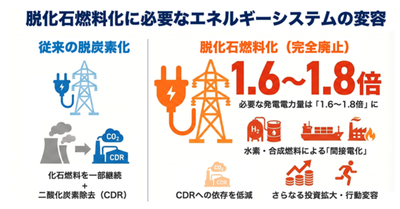
(作成:森翔太郎、NotebookLM)
<関連情報>
- https://www.t.kyoto-u.ac.jp/ja/research/topics/20260519
- https://www.nature.com/articles/s41467-026-72841-7
1.5℃目標達成に向けた化石燃料の完全廃止の課題と機会 Challenges and opportunities of the full phase-out of fossil fuels under the 1.5 °C goal
Shotaro Mori,Siddharth Joshi,Volker Krey,Ken Oshiro,Oliver Fricko,Takuya Hara & Shinichiro Fujimori
Nature Communications Published:18 May 2026
DOI:https://doi.org/10.1038/s41467-026-72841-7
Abstract
The COP28 decision called for transitioning away from fossil fuels, sparking a growing interest in their full phase-out. However, energy system transformation pathways towards a phase-out of fossil fuels, which may reduce the reliance on carbon dioxide removal to meet the 1.5 °C goal, remain unclear. Here, we employ two global energy system models to explore energy system transformations and the challenges and opportunities associated with attaining a full phase-out of fossil fuels. We found that phasing out fossil fuels by 2050 would require accelerating direct and indirect electrification, involving 1.6–1.8-fold increases in power generation compared to the conventional cost-effective 1.5 °C pathways. This transition from cost-effective to fossil fuel phase-out pathways would increase energy supply investments by up to 34% over this century and require accelerated deployment of solar and wind power, as well as electrolysers. Despite opportunities including lower reliance on carbon dioxide removal and increasing probability of returning to 1.5 °C after temperature overshoot, these additional requirements imply that international society must approach the transition towards zero-fossil energy systems with strong determination.