2026-05-18 米国国立標準技術研究所(NIST)
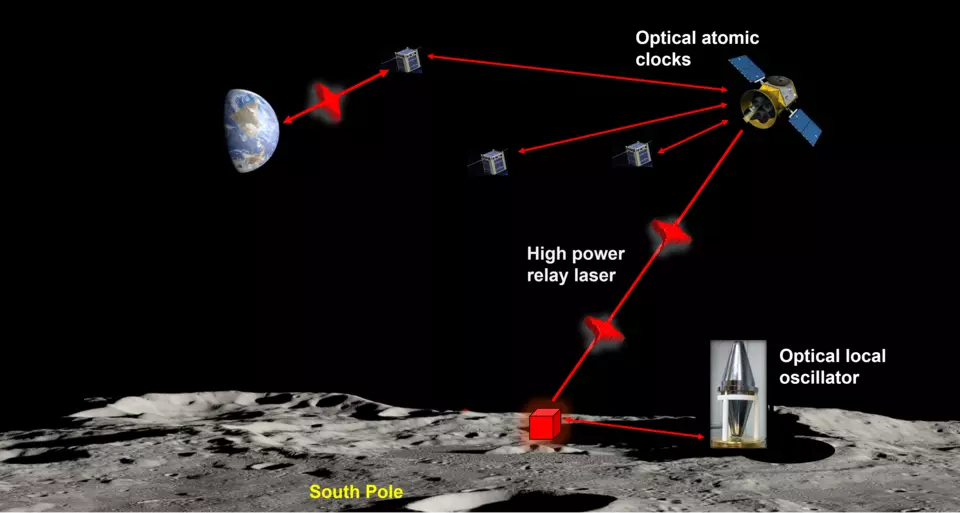
A lunar laser locked to an ultrastable silicon cavity placed inside one of the Moon’s permanently shadowed craters could provide the infrastructure for a lunar time scale, Earth-Moon optical communication, satellite-based space distance measurements and imaging, and a space-based optical atomic clock. Credit: J. Ye/NIST with lunar background image produced by NASA’s Visualization Studio
<関連情報>
- https://www.nist.gov/news-events/news/2026/05/shooting-moon-ultrastable-lasers-dark-craters-could-enable-lunar-navigation
- https://www.pnas.org/doi/abs/10.1073/pnas.2604438123
月面シリコン空洞 Lunar silicon cavity
Jun Ye, Zoey Z. Hu, Ben Lewis, +4 , and Julian Struck
Proceedings of yhe National Academy of Sciences Published:May 8, 2026
DOI:https://doi.org/10.1073/pnas.2604438123
Significance
Physical conditions at the Moon’s permanently shadowed regions are ideal for constructing an ultrastable optical resonator. This passively cooled optical cavity will stabilize a laser with unprecedentedly long phase coherence time, surpassing the best terrestrial laser by more than a decade. The lack of atmosphere allows a precise optical link between the lunar station and surrounding satellites, transferring the stable optical frequency to space. This lunar-based stable laser thus provides a foundational capability to grow quantum technology in space, including establishing a space-borne optical atomic clock that can serve as the lunar time standard, building long-baseline optical interferometry, distribution of stable optical signals across networks of satellites, testing general relativity, and serving as the backbone for space-based quantum networks.
Abstract
The Moon’s permanently shadowed regions (PSRs) are among the coldest places in the Solar System and are expected to become key landing sites for upcoming international space agency missions. Their proximity to peaks of perpetual solar power and potential resource richness makes them prime candidates for lunar exploration and future Moon bases. Here, we propose to deploy a passive, ultrastable optical resonator in these regions that will enable laser systems with unprecedented phase-coherence. The unique physical environment of lunar PSRs greatly benefits the construction of a cryogenic monolithic silicon cavity that exhibits low 10-18 thermal noise-limited stability and coherence time exceeding 1 min, more than a decade better than the current best terrestrial system. Such a stable laser will form an enabling infrastructure for quantum technology in space to serve many applications, including establishing a lunar time standard, building long-baseline optical interferometry, distribution of stable optical signals across networks of satellites, testing general relativity and gravitational physics, and forming the backbone for space-based quantum networks.