2026-08-03 ワシントン州立大学(WSU)
<関連情報>
- https://news.wsu.edu/press-release/2026/08/03/new-tool-can-help-utilities-prepare-for-extreme-weather/
- https://ietresearch.onlinelibrary.wiley.com/doi/10.1049/gtd2.70330
異常気象事象に対する電力システムのレジリエンス重視の計画 Resilience-Driven Planning of Electric Power Systems Against Extreme Weather Events
Abodh Poudyal, Shishir Lamichhane, Josue Campos do Prado, Anamika Dubey
IET Generation, Transmission & Distribution Published: 22 May 2026
DOI:https://doi.org/10.1049/gtd2.70330
ABSTRACT
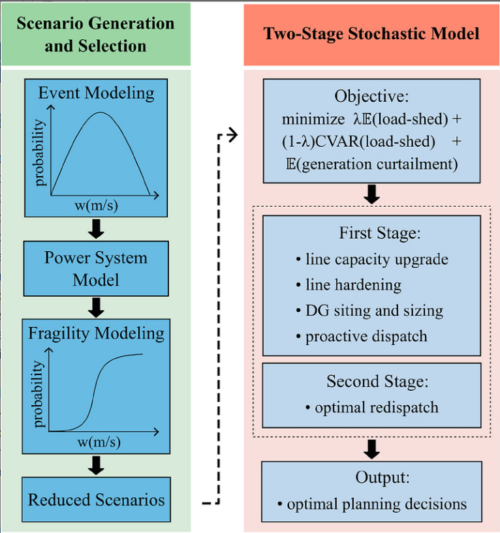
With the increasing frequency of natural disasters, operators must prioritize improvements in the existing electric power grid infrastructure to enhance its resilience. Resilience against extreme weather events requires the grid planners to account for high-impact, low-probability (HILP) events during the planning stage. This paper proposes a resilience-driven two-stage stochastic planning model that jointly optimizes proactive generation dispatch, line hardening, line capacity upgrade and distributed generation sizing and siting decisions to minimize both load sheding and its risk for extreme weather scenarios. The risk is modelled using conditional value-at-risk (CVaR), and a representative scenario sampling method is used to alleviate computational complexity without sacrificing solution quality over a wide range of scenarios. The overall framework is tested on a standard IEEE reliability test system to evaluate the effectiveness of the proposed approach and also validated using out-of-sample scenarios. Several planning portfolios are presented that can help system planners identify trade-offs between system resilience, planning budget, and risk aversion and prioritize the investments. The results suggest that line hardening is the most effective resilience-enhancing investment under limited budgets, while the combination of line hardening and backup DGs minimizes the risk further as the planning budget increases.