2026-03-02 アメリカ合衆国・コーネル大学
Provided
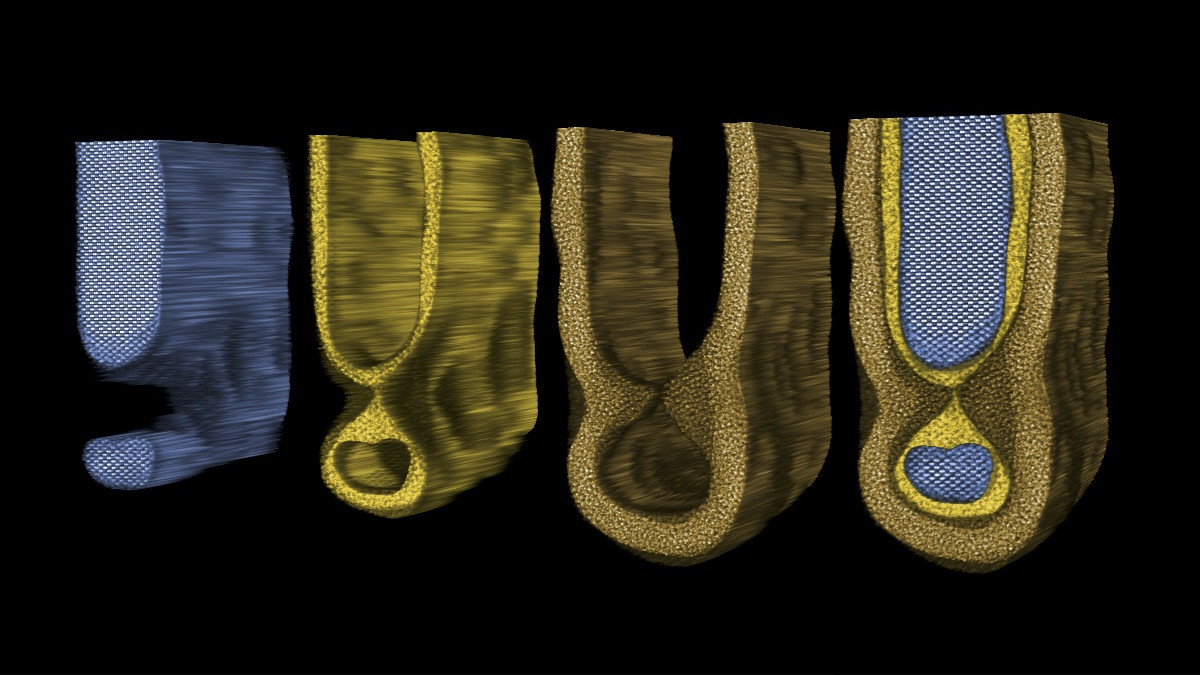
This image shows the silicon, silicon dioxide and hafnium oxide layers inside a transistor channel.
<関連情報>
- https://news.cornell.edu/stories/2026/03/electron-microscopy-shows-mouse-bite-defects-semiconductors
- https://www.nature.com/articles/s41467-026-69733-1
電子プティコグラフィーによるゲートオールアラウンドトランジスタの歪み緩和と粗さの3D原子スケール計測 3D atomic-scale metrology of strain relaxation and roughness in Gate-All-Around transistors via electron ptychography
Shake Karapetyan,Steven E. Zeltmann,Glen Wilk,Ta-Kun Chen,Vincent D.-H. Hou & David A. Muller
Nature Communications Published:23 February 2026
DOI:https://doi.org/10.1038/s41467-026-69733-1
Abstract
Next-generation semiconductor devices are adopting three-dimensional (3D) architectures with feature sizes in the few-nanometer regime, creating a need for atomic-scale metrology to identify and resolve performance-limiting fabrication challenges. X-ray methods provide 3D information but lack atomic resolution, while conventional electron microscopy offers limited depth sensitivity. Here we show how multislice electron ptychography, a computational microscopy technique with sub-Ångström lateral and nanometer-scale depth resolution, enables 3D imaging of buried device structures. We image prototype gate-all-around transistors and directly quantify roughness, strain, and defects at the interface of the 3D gate oxide wrapped around the channel. We find that silicon in the 5-nm-thick channel relaxes away from the interfaces, leaving only ~60% of atoms in a bulk-like structure. From a single dataset, ptychography provides quantitative metrology of atomic-scale interface roughness in 3D, previously accessible only through indirect inference, along with strain and other structural parameters needed for device modeling and process development.