2026-04-29 中国科学院(CAS)
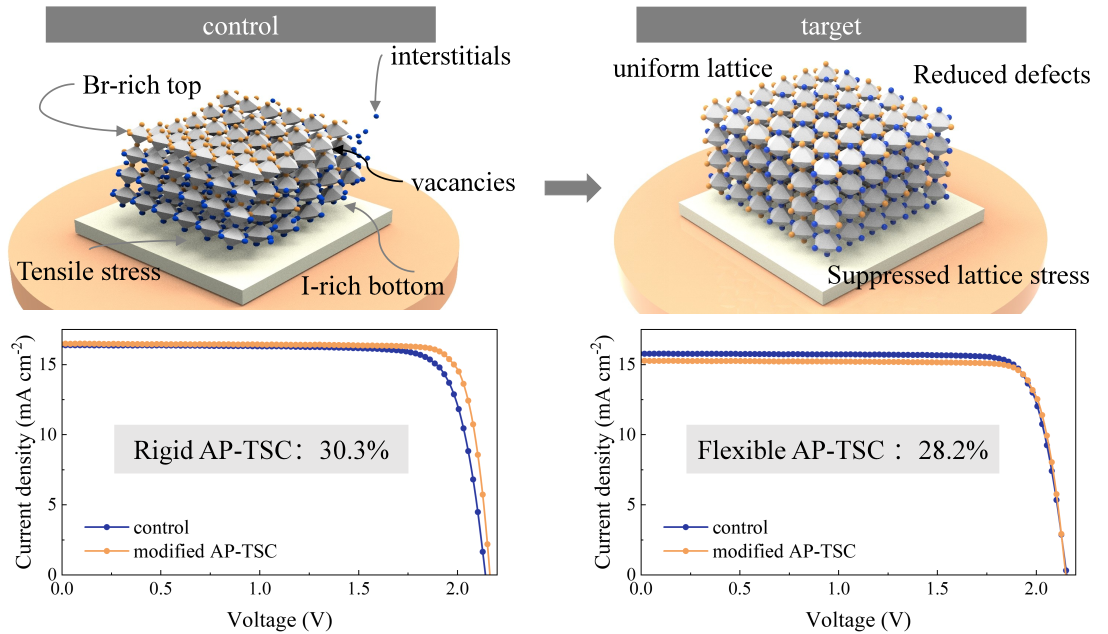
Synchronized crystallization enables efficient rigid and flexible perovskite tandems (Image by NIMTE)
<関連情報>
- https://english.cas.cn/newsroom/research-news/202604/t20260430_1158282.shtml
- https://www.nature.com/articles/s41565-026-02165-6
化学的硬度工学によりペロブスカイトタンデムにおける結晶化が同期化される Chemical hardness engineering synchronizes crystallization in perovskite tandems
Ruijia Tian,Kexuan Sun,Yuanyuan Meng,Jiahan Xie,Yaohua Wang,Xiaoyi Lu,Jingnan Wang,Shujing Zhou,Ming Yang,Haibin Pan,Yang Bai,Zhenhua Song,Yingguo Yang,Quan Liu,Bin Han,Bencan Tang,Darren A. Walsh,Hainam Do,Chang Liu & Ziyi Ge
Nature Communications Published:27 April 2026
DOI:https://doi.org/10.1038/s41565-026-02165-6
Abstract
All-perovskite tandem solar cells are constrained by asynchronous crystallization in multicomponent perovskites, which produces vertical compositional gradients, structural inhomogeneity and excessive non-radiative recombination. These effects arise from mismatched coordination and crystallization kinetics among mixed halides and Pb2+/Sn2+ cations. Here we establish a generalizable additive design strategy guided by hard–soft acid–base principles to synchronize nucleation and crystal growth in both wide- and narrow-bandgap perovskites. Borderline-base difluoro(oxalato)borate and hard-base tetrafluoroborate selectively coordinate wide- and narrow-bandgap perovskite precursors, respectively, balancing the crystallization kinetics of PbI2/PbBr2 and PbI2/SnI2 and producing vertically uniform perovskite films with reduced defect densities and suppressed ion migration. In situ optical and structural characterization reveals homogeneous nucleation and direct crystal growth without intermediate halide redistribution. Monolithic two-terminal tandems achieve an efficiency of 30.3% (certified, 30.3%) with improved open-circuit voltage (2.16 V) and fill factor (85.2%), retaining 92% efficiency after 1,000 h of maximum power point tracking. Flexible tandems reach an efficiency of 28.2% (certified, 28.0%). These results establish chemical hardness matching as a universal principle for controlling crystallization in different perovskite systems.