
2026-05-04 カリフォルニア大学バークレー校(UCB)
<関連情報>
- https://engineering.berkeley.edu/news/2026/05/researchers-discover-a-new-pathway-to-building-energy-efficient-computing-chips/
- https://www.science.org/doi/10.1126/science.aec9417
原子スケールの二酸化チタン誘電体膜における強誘電性 Ferroelectricity in atomic-scale titanium dioxide dielectric films
Koushik Das, Kate Reidy, Sajid Husain, Jong Ho Park, […] , and Sayeef Salahuddin
Science Published:5 Mar 2026
DOI:https://doi.org/10.1126/science.aec9417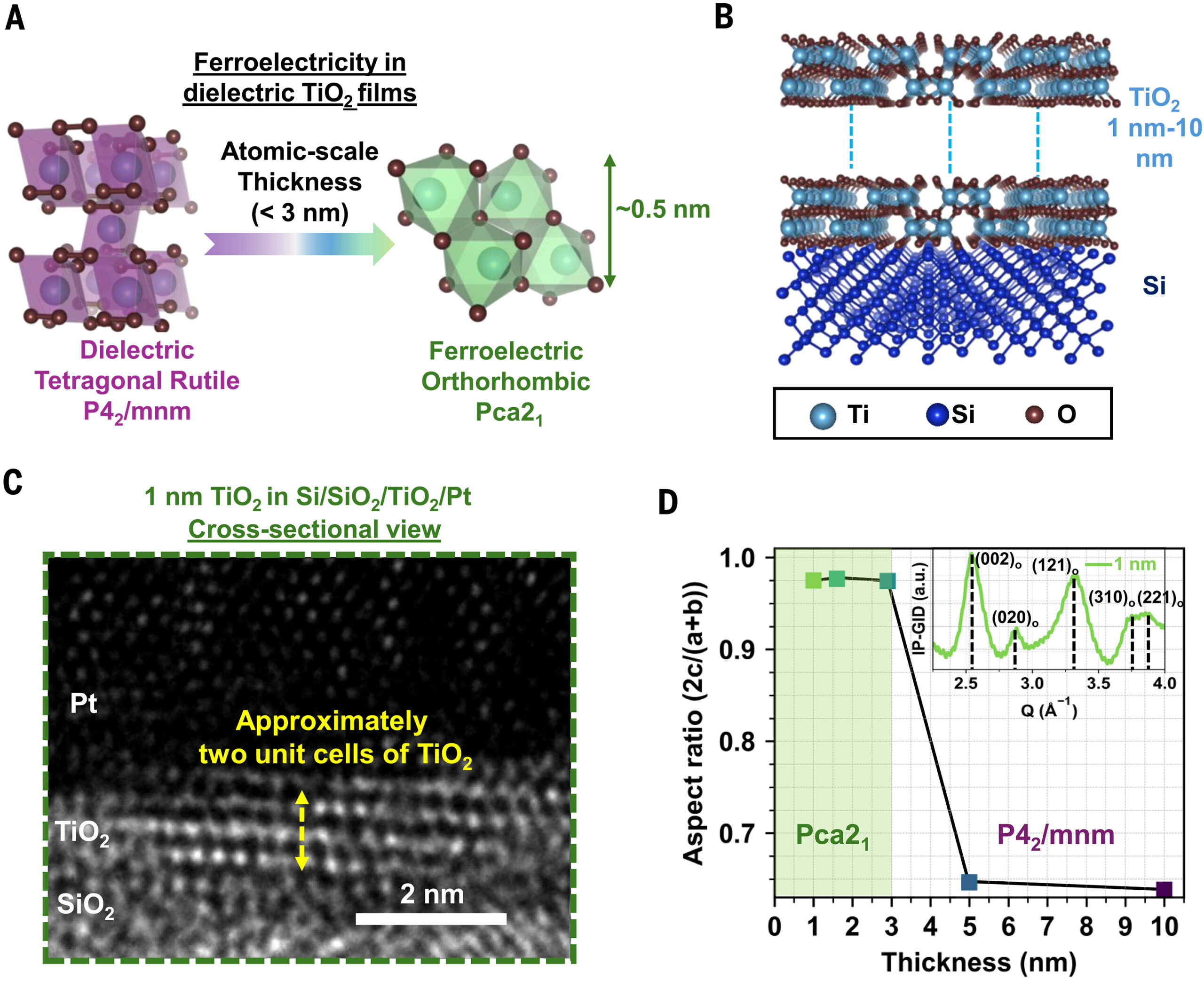
Editor’s summary
Titanium dioxide is normally a dielectric, but in films with thicknesses below 3 nanometers, it forms a ferroelectric phase by breaking structural inversion symmetry. Das et al. grew such films through atomic-layer deposition, not only on crystalline silicon, but also on amorphous silicon and carbon. The ferroelectric phase was still present in films 1 nanometer thick (about two unit cells). The slanted polarization of this material can enable in-plane polarization switching for applications in integrated electronics. —Phil Szuromi
Abstract
Ferroelectricity at atomic-scale thickness would have important applications in next-generation electronics. Here, we report that a ferroelectric phase can be stabilized in titanium dioxide (TiO2) films, a commonly known dielectric that is widely used in semiconductor technologies, by reducing thickness to <3 nanometers. Importantly, this ferroelectricity persists down to 1-nanometer thickness, approximately twice the unit-cell dimension. This thickness-dependent dielectric-to-ferroelectric phase transition demonstrates that an otherwise centrosymmetric, nonferroic fluorite-structure oxide can undergo structural inversion-symmetry breaking and exhibit voltage-switchable polarization. Atomic layer deposition–based low-temperature (<400°C) synthesis and the stability of this ferroelectricity on both silicon (Si) and amorphous surfaces [such as amorphous silicon dioxide (SiO2) and amorphous carbon films] demonstrate the feasibility of integration with a large variety of materials.

