2026-05-22 東京海洋大学
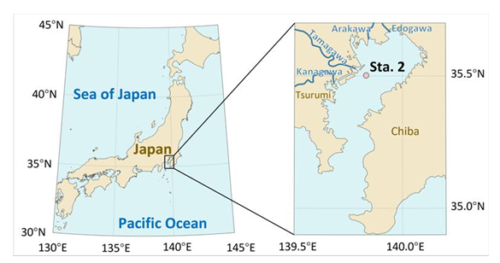
図1 MPの採取点
<関連情報>
- https://www.kaiyodai.ac.jp/upload-file/6c7e16cf75f76674bd69373af1a7f65856929fe0.pdf
- https://www.sciencedirect.com/science/article/pii/S3051060026000247
東京湾湾奥の海底堆積物コアの分析により、プラスチックの生産と堆積の間に10年程度のタイムラグがあることを明らかにした Sediment core analysis from inner Tokyo Bay reveals a decadal lag between plastic production and deposition
Said M. Hashim, Zijiang Yang, Hisayuki Arakawa
Journal of Hazardous Materials: Plastics Available online: 11 May 2026
DOI:https://doi.org/10.1016/j.hazmp.2026.100061
Highlights
- The study quantifies Microplastics (MPs) in sediment cores from inner Tokyo Bay, Japan.
- The MPs concentrations decrease with sediment depth.
- PE is the most abundant polymer across all sediment depths.
- The MPs’ particle sizes peak consistently in the 40–60 µm range.
- The sediment MPs concentrations align with plastic production, with a 6–14-year lag.
Abstract
In this study, microplastics (MPs) concentrations were analyzed in triplicate 35-cm sediment cores from inner Tokyo Bay. The results revealed an increase in MPs deposition in the upper sediment layers, with the highest concentration (25.9 ± 3.0 particles g⁻¹ dry weight, DW) in the topmost layer and the lowest (8.4 ± 7.9 particles g⁻¹ DW) at the deepest depth. Polyethylene (PE) was the dominant polymer across all layers, followed by copolymers and polypropylene (PP). Particle sizes peaked at 40–60 µm, with polyethylene terephthalate (PET) showing larger particle sizes and higher aspect ratios compared to other polymers, while PE exhibited the smallest. MPs concentrations aligned with local plastic production trends, with a delay of 6–14 years between production and deposition. Similarly, PET concentrations mirrored its production and recycling rates. These findings highlight how both production and recycling influence plastic pollution, concomitantly underscoring their role as key strategies in combating its accumulation in marine environments.