2026-06-02 京都大学
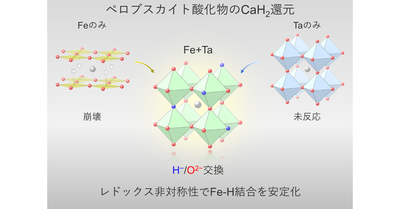
還元されやすい鉄と還元されにくいタンタルを組み合わせることで、レドックス非対称性により初の鉄系ペロブスカイト型酸水素化物の合成に成功(Kyoto Univ. and Hokkaido Univ. / Yuki Sasahara)
<関連情報>
- https://www.t.kyoto-u.ac.jp/ja/research/topics/20260602
- https://pubs.acs.org/doi/10.1021/jacs.6c06588
レドックス非対称性によりペロブスカイト型酸水素化物で鉄–水素結合を実現 Redox Asymmetry Enables Fe–H Bonds in Perovskite Oxyhydrides
Yuki Sasahara,Susumu Fujii,Daichi Kato,Rina Terada,Tomoko Onoue,Kei Saito,Kei Morisato,Suraj Mahato,Ryotaro Tanabe,Masatomo Yashima,Ko Mibu,and Hiroshi Kageyama
Journal of the American Chemical Society Published: June 1, 2026
DOI:https://doi.org/10.1021/jacs.6c06588
Abstract
Transition-metal oxyhydrides have attracted considerable interest because incorporation of hydride anions endows oxides with distinctive structural, electronic, and catalytic functionalities. Although CaH2 topochemical reduction has enabled various transition-metal oxyhydrides (e.g., V, Ti, Co, and Ru), Fe-based oxides exclusively form oxygen-deficient phases such as SrFeO2, whereas oxides containing redox-inert cations such as Ta5+, Nb5+, or Hf4+ remain essentially unreactive. Here we show that combining Fe with such redox-inert cations in B-site solid-solution perovskites overcomes both limitations and enables the synthesis of BaFe0.5Ta0.5O2.7H0.3, in which Fe is selectively reduced while Ta remains pentavalent. Density functional theory calculations reveal that O2–/H– substitution stabilizes the structure by relieving the local strain associated with oxygen-vacancy formation. The resulting Fe–H bonds are remarkably robust, persisting in the mixed-valent Fe2+/Fe3+ configuration, whereas Fe–H bonds in molecular complexes are generally limited to lower oxidation states. Extension of this strategy to B-site Fe/Nb and Fe/Hf solid-solution perovskites likewise yields their corresponding oxyhydrides. These results establish a general design principle for stabilizing chemically robust Fe–H bonds in perovskites and other structures.