2026-06-01 ピッツバーグ大学
<関連情報>
- https://news.engineering.pitt.edu/slick-science/
- https://asmedigitalcollection.asme.org/tribology/article/147/9/091111/1213230/Validation-of-a-Multiscale-Hysteresis-Mechanics
様々な仕上げの表面における油まみれの靴と床との摩擦を予測するためのマルチスケールヒステリシス力学モデルの検証 Validation of a Multiscale Hysteresis Mechanics Model in Predicting Oily Shoe-Floor Friction Across Surfaces With Varying Finishes
Henry Ing,Vimanyu Chadha,Anna B. Randolph,Ky Reifler,Tevis D.B. Jacobs,Kurt E. Beschorner
Journal of Tribology Published:April 3, 2025
DOI:https://doi.org/10.1115/1.4068109
Abstract
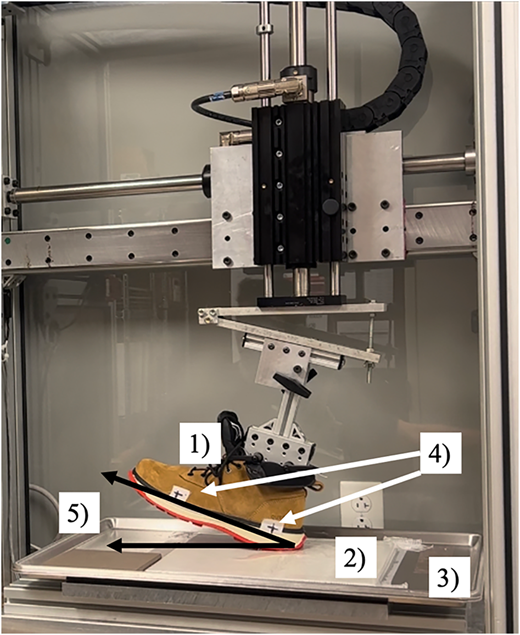
Shoe-floor friction, quantified by the coefficient of friction (COF), is an important predictor of the risk of slip-and-fall accidents. There is a commonly used model of friction by B. Persson that describes viscoelastic dissipation due to hysteretic properties of rubber. Applied to shoe-floor friction, the model calculates the COF by using two primary inputs: (1) the multiscale surface topography of floor tiles and (2) the time-dependent material properties of the shoe rubber. While this theory is well accepted by many theoreticians and modelers, there is almost no direct experimental validation. Here, the model is tested by comparing against experimental measurements of COF using three different designs of shoes, ten different porcelain-tile floors, and canola oil as a contaminant. The results demonstrated that, while the model was predictive of trends, its values were too large by an average of 1050% when all scales of topography were included. However, this predictive power was improved (p < .0001, RMSerror= 0.066) when the range of size scales of topography was limited to exclude the smallest-scale topography features. Scientifically, these findings provide new insights about which length scales of topography are most relevant to performance under different conditions. For real-world application, these results show the potential of this model to be used by floor designers and engineers to develop or select materials to create slip-resistant shoes and flooring. This would then create safer workplace environments, decreasing the significant economic burden and human suffering caused by slip-and-fall accidents.