2026-04-28 パシフィック・ノースウェスト国立研究所(PNNL)
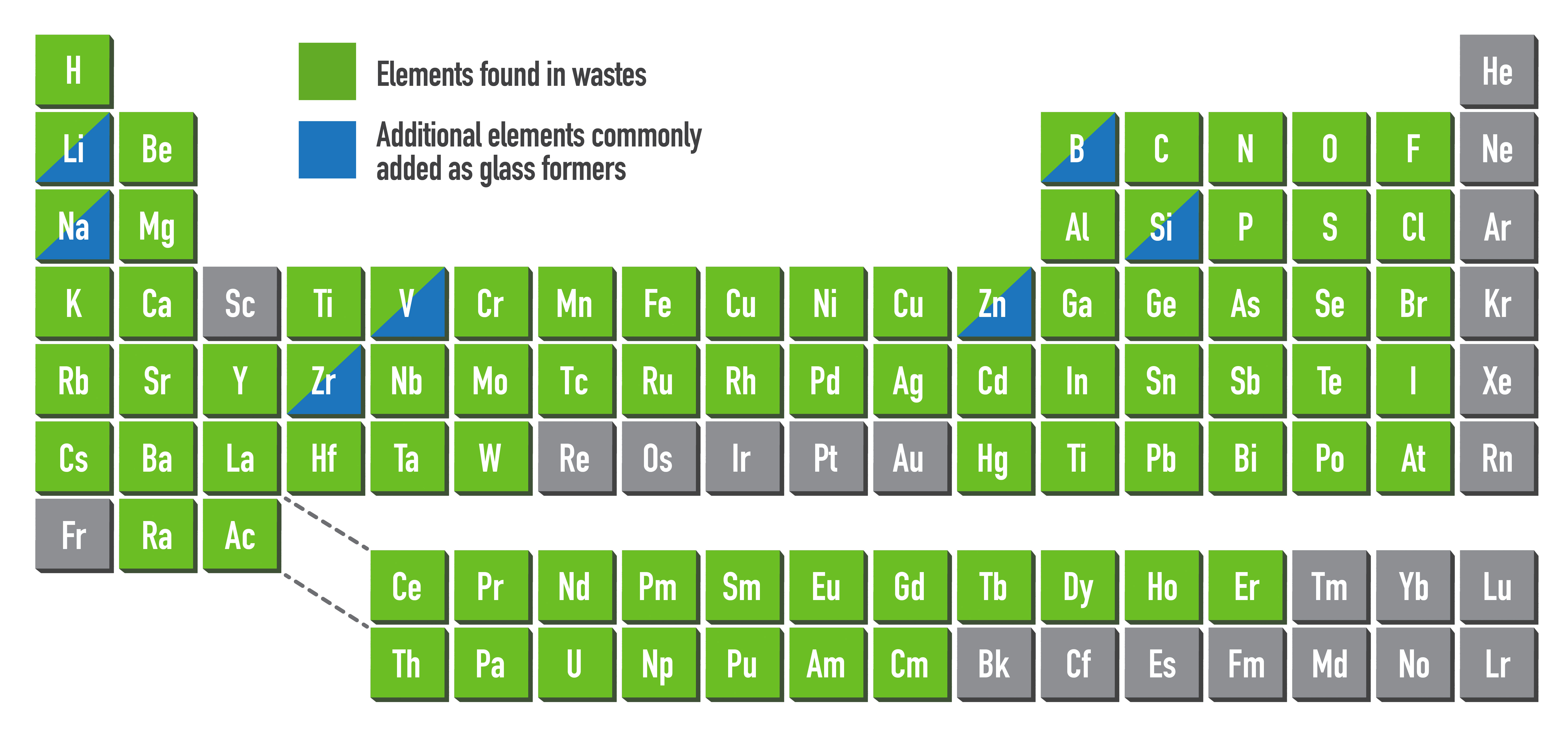
Shown here in green, the majority of the elements in the periodic table can be found in the legacy tank wastes being stored and treated at the Hanford Site. Many of these elements, such as phosphorus and bismuth, are in significantly large concentrations compared with waste being treated at other cleanup sites. (Figure by Brian Riley, David Peeler, and Derek Munson | Pacific Northwest National Laboratory)
<関連情報>
- https://www.pnnl.gov/news-media/pnnl-scientists-leverage-ai-optimize-glass-formulas-liquid-radioactive-waste
- https://www.sciencedirect.com/science/article/abs/pii/S0022309326000499#sec0020
機械学習による特性モデルを用いた低放射性廃ガラスの最適化、パート2:実験的検証とアクティブラーニング Low activity waste glass optimization with property models from machine learning, part 2: Experimental validation and active learning
Xiaonan Lu, Vivianaluxa Gervasio, Pavel Ferkl, Joelle T Reiser, Miroslava Peterson, Jesse Westman, Jaime L George, Saehwa Chong, Brian J Riley, Nicholas A Lumetta, Derek A Cutforth, Dewei Wang, Nathan L Canfield, Jared Oshiro, José Marcial, Jarrod V Crum, James J Neeway, John D Vienna
Journal of Non-Crystalline Solids Available online: 18 February 2026
DOI:https://doi.org/10.1016/j.jnoncrysol.2026.123990
Abstract
The United States Department of Energy is responsible for managing legacy nuclear waste stored in underground tanks at the Hanford Site. The current baseline plan to treat the waste is to separately vitrify low-activity waste (LAW) and high-level waste fractions. Previously, machine learning (ML) based glass property models (e.g., chemical durability, viscosity, electrical conductivity and SO3 solubility) were developed with prediction uncertainties. A waste glass optimization approach was then established to enable the capability of using these ML models in LAW glass formulation. In this study, the previous ML models were first experimentally validated, and the results were incorporated back into the database to update the ML models. The updated models and formulations showed increased waste loading while reducing the failure rate, demonstrating improved predictive accuracy, reduced uncertainties, and the effectiveness of active learning in guiding high-dimensional, nonlinear LAW glass design. This represents the first experimental validation of ML based LAW glass formulation, with practical benefits such as higher waste loading, shorter mission duration, and lower operational risk.