2026-04-24 北海道大学,モルゲンロット株式会社,大阪公立大学,中央大学,新潟大学
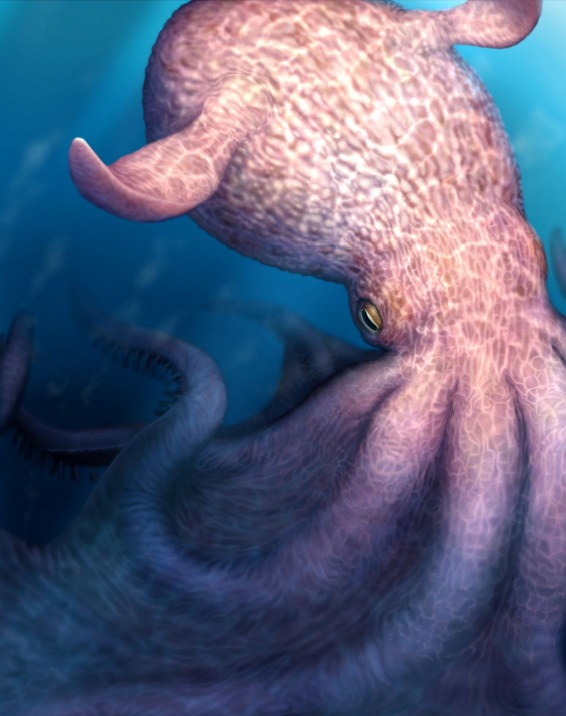
白亜紀の巨大なタコの復元画
<関連情報>
- https://www.hokudai.ac.jp/news/2026/04/ai-9.html
- https://www.hokudai.ac.jp/news/pdf/260424_pr.pdf
- https://www.science.org/doi/10.1126/science.aea6285
最古のタコは白亜紀の海洋における巨大な頂点捕食者だった Earliest octopuses were giant top predators in Cretaceous oceans
Shin Ikegami, Jörg Mutterlose, Kanta Sugiura, Yusuke Takeda, […] , and Yasuhiro Iba
Science Published:23 Apr 2026
DOI:https://doi.org/10.1126/science.aea6285
Editor’s summary
The Kraken, the giant cephalopod of legend, was feared by sailors for centuries. Later interpretations suggested that it may have been based on sightings of the giant squid, which can be 10 meters long. Although they lived far too early to have been the source of the legend, Ikegami et al. describe fossil octopods from the late Cretaceous that truly would have fit the description of the monster, reaching up to 19 meters in length. Wear patterns on their jaws suggest that these octopods preyed upon the large reptiles present at the time, including plesiosaurs and mosasaurs. The authors interpret asymmetry in these wear patterns as an indication of corresponding asymmetry in behavior, suggesting complex brain development and, potentially, high intelligence. —Sacha Vignieri
Abstract
Top predators drive changes in ecosystem structure. For the last ~370 million years, large-sized vertebrates have dominated the apex of the marine food chain, while invertebrates have served as smaller prey. Here we describe invertebrate top predators from this “age of vertebrates,” the earliest finned octopuses (Cirrata) from Late Cretaceous sediments (~100 to 72 million years ago), as identified based on huge, exceptionally well-preserved fossil jaws and their wear. This extensive wear suggests dynamic crushing of hard skeletons. Asymmetric wear patterns further indicate lateralized behavior, suggesting advanced intelligence. With a calculated total length of ~7 to 19 meters, these octopuses may represent the largest invertebrates thus described, rivaling contemporaneous giant marine reptiles. Our findings show that powerful jaws, and the loss of superficial skeletons, convergently transformed cephalopods and marine vertebrates into huge, intelligent predators.