2026-06-03 北海道大学
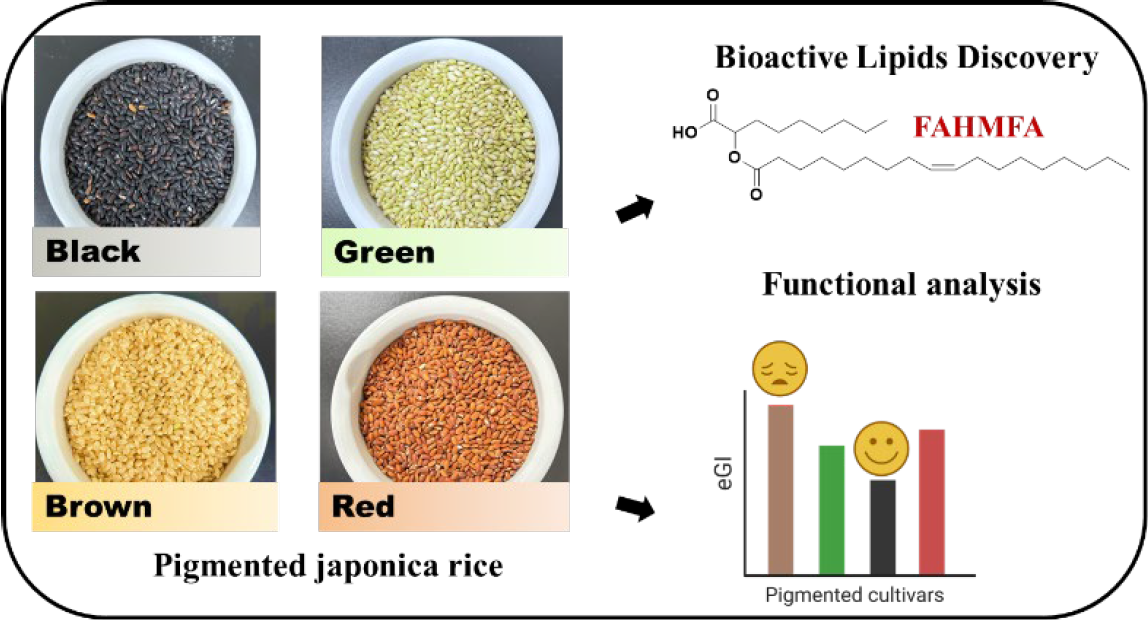
研究の概要図
<関連情報>
- https://www.hokudai.ac.jp/news/2026/06/56-1.html
- https://www.sciencedirect.com/science/article/abs/pii/S0963996925022331
56品種のジャポニカ米における脂質プロファイリング及びヒドロキシ脂肪酸由来の新規脂肪酸エステルの同定 Lipidomic profiling of 56 japonica rice cultivars and identification of novel fatty acid esters of hydroxy fatty acids
Lipsa Rani Nath, Siddabasave Gowda B. Gowda, Divyavani Gowda, Perumalsamy Parasuraman, Wei Qin, Shu-Ping Hui
Food Research International Available online: 13 November 2025
DOI:https://doi.org/10.1016/j.foodres.2025.117895
Highlights
- Lipidomics of 56 japonica rice cultivars revealed 196 lipid molecules.
- Discovery of novel bioactive lipids like FAHFAs and LNAPEs in rice grains.
- Black and green rice showed favorable lipid profiles and health-promoting potential.
- Pigmentation and farming practices influence lipid composition in rice.
- Findings support breeding nutritionally superior rice for health benefits.
Abstract
Pigmented japonica rice cultivars are a rich source of nutritionally significant lipids, yet their comprehensive lipidomic profiles remain poorly characterized. In this study, we performed untargeted liquid chromatography-mass spectrometry-based lipidomics on 56 japonica rice cultivars from Japan to examine the influence of grain pigmentation on lipid composition. A total of 196 lipid molecules across five major lipid classes were annotated. Most importantly, we report for the first time in rice the presence of a novel group of bioactive lipids, fatty acid esters of hydroxy medium-chain fatty acids (FAHMFAs), belonging to the fatty acyl category. These lipids were abundant in brown and green pigmented rice cultivars and were confirmed by MS/MS spectral analysis and comparison with authentic standards. Additionally, N-acyl-lysophosphatidylethanolamines (LNAPEs), a class of phospholipids, were characterized and found to be enriched in black rice. Pigmented cultivars also exhibited favorable lipid-based nutritional indices, particularly those enriched in polyunsaturated fatty acids. Multivariate statistical analysis revealed distinct lipid signatures differentiating organic from conventional cultivation, primarily driven by fatty acyls and glycerophospholipids. The estimated glycemic index (eGI) of selected cultivars was also assessed, with black rice showing the lowest eGI, indicating its potential benefits for blood glucose regulation and metabolic health. This study provides the first comprehensive evidence of FAHMFAs and LNAPEs in rice, revealing the diverse bioactive lipid composition of pigmented japonica cultivars and their potential for functional food development. However, the findings are limited to japonica varieties and warrant further validation across broader rice types.