2026-06-02 東京科学大学
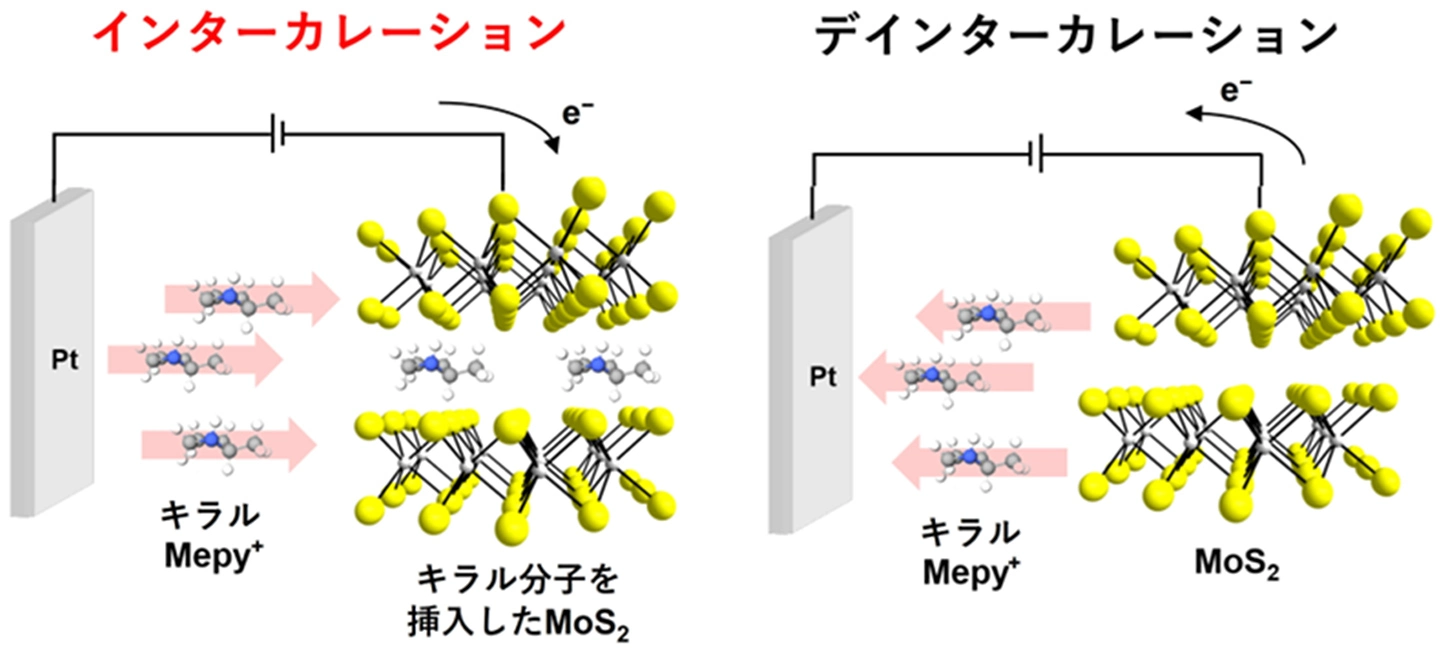
図1. 層状半導体MoS2の層間へキラル分子(キラルMepy+)を可逆的に挿入および脱離(インターカレーションおよびデインターカレーション)
<関連情報>
層状ファンデルワールス材料におけるエナンチオピュア分子カチオンの電気化学的インターカレーション制御によるキラリティの可逆的オンオフスイッチング Reversible On–Off Switching of Chirality via Electrochemical Intercalation Control of Enantiopure Molecular Cations in a Layered van der Waals Material
Po-Jung Huang,Hiroaki Kusunoki,Daisuke Nishio-Hamane,and Kouji Taniguchi
ACS Nano Published: May 17, 2026
DOI:https://doi.org/10.1021/acsnano.6c04758
Abstract
Manipulating chirality in materials facilitates the precise control of fascinating chirality-induced functionalities, such as chirality-induced spin selectivity (CISS) and electrical magnetochiral effect (eMChE). Recently, the intercalation of chiral molecules into layered van der Waals (vdW) materials has emerged as an effective technique for introducing chirality into materials. In particular, electrochemical methods offer a promising route for artificial chirality control, as they enable reversible ion intercalation and deintercalation via electrical manipulation. Herein, we achieve reversible on–off switching between chiral and achiral states in layered MoS2 through the intercalation and deintercalation of a small-sized chiral cation, the (R)/(S)-methylpyrrolidinium ion, which is smaller than the MoS2 vdW gap. CISS and eMChE, the chirality-dependent electron transport phenomena, are used as indicators of chirality in this study. Importantly, we observe the appearance and disappearance of CISS signals in chiral molecule-intercalated and deintercalated MoS2, respectively. These results demonstrate that combining small chiral molecular ions with layered vdW materials enables the reversible electrical control of emergent chirality-induced functionalities.