2026-036-02 カナダ・コンコルディア大学
<関連情報>
- https://www.concordia.ca/news/stories/2026/06/02/conifers-are-making-a-comeback-in-quebecs-forests-new-concordia-study-shows.html
- https://link.springer.com/article/10.1007/s11676-026-02052-9
針葉樹構成の変化の追跡:ケベック州の森林における30年間にわたる地上および衛星データに基づく評価 Tracking conifer composition change: a ground and satellite based assessment of Quebec’s forests over three decades
Jennifer Donnini & Angela Kross
Journal of Forestry Research Published:18 April 2026
DOI:https://doi.org/10.1007/s11676-026-02052-9
Abstract
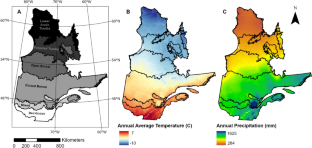
Studies in Quebec have reported contrasting trends in conifer composition, with some documenting long-term declines while others suggest increases. This study examined changes in conifer basal area percentage (CBAP) from 1985 to 2021 using 1796 permanent forest inventory plots across deciduous, mixed, and boreal forest zones and evaluates Landsat based Cubist regression models from two time periods (1992/1993—2016/2017) to monitor these shifts. Field data showed a consistent increase in CBAP over time, with nearly 50% of all plots showing increases, especially in mixed forests where balsam fir (Abies balsamea) accounted for much of the observed change. This trend may reflect successional processes in stands recovering from the last major spruce budworm outbreak (1972–1986) and forest tent caterpillar outbreaks in the province. Cubist models predicting CBAP and trained on Landsat-8 imagery from 2016/2017 had the best performance overall, with an average R2 of 0.679, correlation of 0.82, and lowest average error (14.1%). To improve comparability across sensors and years, we selected a combined model (M24) trained on data from both time periods to generate spatial predictions. The model achieved an R2 of 0.633 and used only four untransformed spectral bands within a single rule. This model effectively reproduced the median CBAP values through time at the regional scale, predicting medians of 38.3% (observed: 39.3%) in 1992/1993 and 62.4% (observed: 60.0%) in 2016/2017, though it underestimated values at the extremes. At the plot level, predicted changes in CBAP were only moderately aligned with observed changes (R2 = 0.241, MAE = 17.31, RMSE = 22.18). Overall, our findings demonstrate that satellite-based models can reliably detect broad trends in forest composition, and integrating CBAP into remote sensing workflows provides a scalable, interpretable approach for long-term ecological monitoring and forest management.