2026-06-02 オックスフォード大学
<関連情報>
- https://www.ox.ac.uk/news/2026-06-02-strange-winds-reveal-strongest-hints-yet-of-magnetic-activity-in-exoplanets
- https://www.nature.com/articles/s41550-026-02870-1
高温巨大系外惑星の磁場強度は太陽系の値と一致する Magnetic field strengths of hot giant exoplanets consistent with Solar System values
Julia V. Seidel,Vivien Parmentier,Bibiana Prinoth,Thea Hood,Nishil Mehta,Valentin De Lia,Konstantin Batygin,Tristan Guillot,Ragnar Van den Broeck,Hayley Beltz,Brian Thorsbro,Florian Debras,Daniel D. B. Koll,Thaddeus D. Komacek,Emily Rauscher,Lorenzo Pino,Matteo Brogi,Joost P. Wardenier,Jacob L. Bean,Björn Benneke,Jean-Michel L. B. Désert,Pablo Drake,Siddharth Gandhi,Mark Hammond,… Kevin B. Stevenson
Nature Astronomy Published:02 June 2026
DOI:https://doi.org/10.1038/s41550-026-02870-1
Abstract
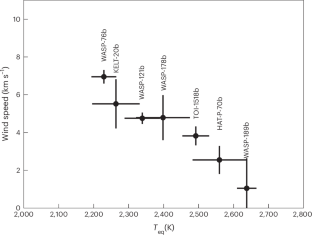
Magnetic fields are a key factor in the evolution of planets and their atmospheres, but they are still poorly constrained for exoplanets owing to limited direct observations. Ultra-hot Jupiters provide a new avenue to probe magnetic effects, as the circulation of their highly ionized atmospheres could be directly sensitive to the atmospheric magnetic field. However, it remains unclear whether the impact of these magnetic effects can be observed directly and used to constrain the magnetic field strength. With high spectral resolution observations targeting the planetary iron lines, we measure the Doppler shift and thus the wind speed of seven transiting ultra-hot Jupiters. Here we find a clear decrease of wind speed with increasing planetary temperature, which is a trend inconsistent with purely hydrodynamic mechanisms but naturally reproduced by magnetic drag. From this relationship, we estimate the possible strength of magnetic fields of hot giant planets to at most a few gauss, which is comparable with the Jovian equatorial field. Our results support the idea that magnetic fields affect the atmospheric circulation of ultra-hot Jupiters and could provide a crucial benchmark for scaling laws used to predict magnetic fields in exoplanets, from hot Jupiters to rocky Earths, with additional implications for future direct observations.