
2026-04-23 ハーバード大学
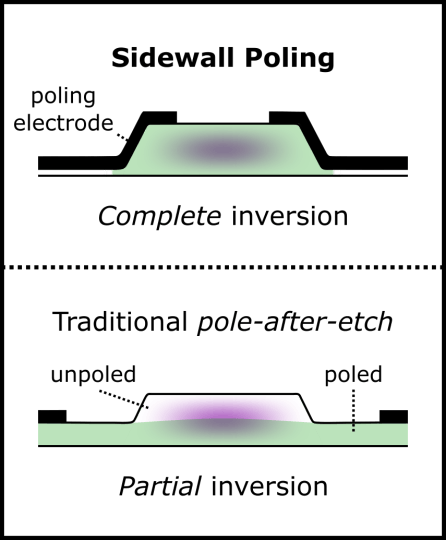
Schematic showing the benefit of sidewall poling vs. traditional pole-after-etch methods.
<関連情報>
- https://seas.harvard.edu/news/ultraviolet-light-fits-chip
- https://www.nature.com/articles/s41467-026-68524-y
側壁分極型ニオブ酸リチウムを用いたミリワットレベルの紫外線発生 Milliwatt-level UV generation using sidewall poled lithium niobate
C. A. A. Franken,S. S. Ghosh,C. C. Rodrigues,J. Yang,C. J. Xin,S. Lu,D. Witt,G. Joe,G. S. Wiederhecker,K.-J. Boller & M. Lončar
Nature Communications Published:21 April 2026
DOI:https://doi.org/10.1038/s41467-026-68524-y
Abstract
Integrated coherent sources of ultra-violet (UV) light are essential for a wide range of applications, from ion-based quantum computing and optical clocks to gas sensing and microscopy. Recently, approaches that use frequency upconversion have received considerable attention. Among these, the integrated thin-film lithium niobate (TFLN) photonic platform shows particular promise. However, to date, the high propagation losses and lack of reliable techniques for consistent poling of cm-long waveguides with small poling periods have impeded progress. Here, we present a sidewall poled lithium niobate (SPLN) waveguide approach that overcomes these obstacles and results in a two-orders-of-magnitude increase in generated UV power. We demonstrate SPLN waveguides featuring record-low propagation losses of 2.3 dB/cm, complete domain inversion across the waveguide cross-section, and an optimum 50% duty cycle, resulting in a record-high normalized conversion efficiency of 5050%W−1cm−2, and 4.2 mW of generated on-chip power at 390 nm wavelength. This advancement makes the TFLN platform a viable option for high-quality on-chip UV generation, benefiting emerging applications.

