2026-04-16 北京大学(PKU)
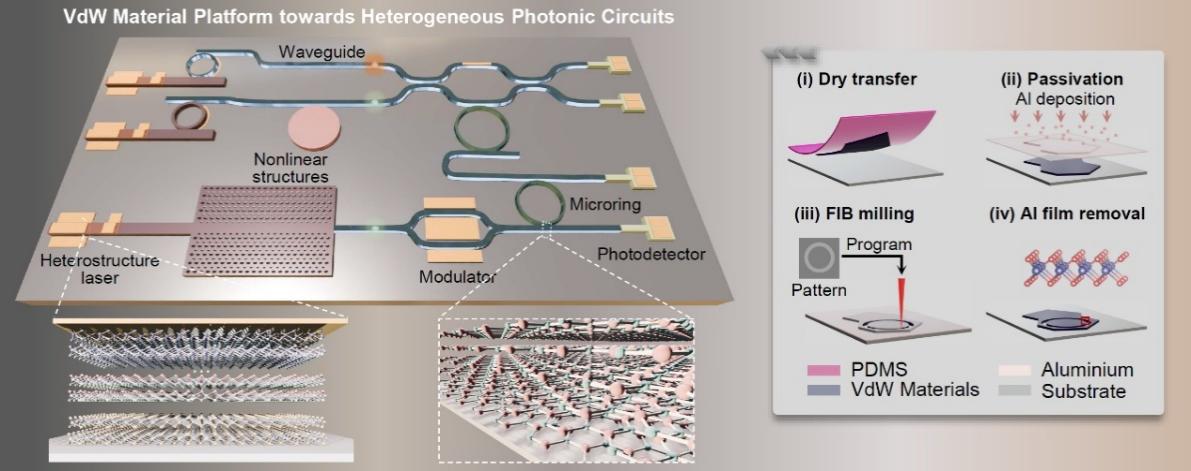
Figure 1. Conceptual illustration of an on-chip heterogeneous photonic circuit based on van der Waals materials and the corresponding general nanofabrication process.
<関連情報>
- https://newsen.pku.edu.cn/news_events/news/research/15469.html
- https://www.nature.com/articles/s41563-026-02574-x
低損失非線形フォトニクス向け全ファンデルワールス型マイクロキャビティ All-van der Waals microcavities for low-loss nonlinear photonics
Zhi-Yan Wang,Xiaoqi Cui,Andreas C. Liapis,Hao-Ran Shao,Xu Cheng,Jingnan Yang,Nianze Shang,Weizhe Zhang,Henri Kaaripuro,Juan C. Arias Muñoz,Kaifeng Lin,Wenjing Liu,Kaihui Liu,Qihuang Gong,Zhipei Sun & Yun-Feng Xiao
Nature Materials Published:13 April 2026
DOI:https://doi.org/10.1038/s41563-026-02574-x
Abstract
Van der Waals (vdW) materials have emerged as a promising platform for next-generation nanophotonics and optoelectronics. However, employing vdW materials as a core photonic integration platform, rather than as passive or active overlays on conventional silicon-based platforms, remains challenging, leaving their full potential untapped. Here we develop a nanofabrication strategy that enables high-resolution patterning across a broad range of vdW materials, including insulators, semiconductors, ferroelectrics and their heterostructures, and we show that they can be used as the intrinsic platform for low-loss microcavity nonlinear photonic devices such as microdisks, photonic crystals and metasurfaces. We demonstrate vdW microdisk resonators with quality (Q) factors exceeding 106. Such Q factors enable efficient continuous-wave nonlinear optical processes, including second-harmonic generation, sum-frequency generation and optical parametric amplification, with full free-spectral-range thermal tunability. These results position vdW materials as key material building blocks for next-generation integrated photonics and optoelectronics.