2026-05-12 ペンシルベニア州立大学(Penn State)
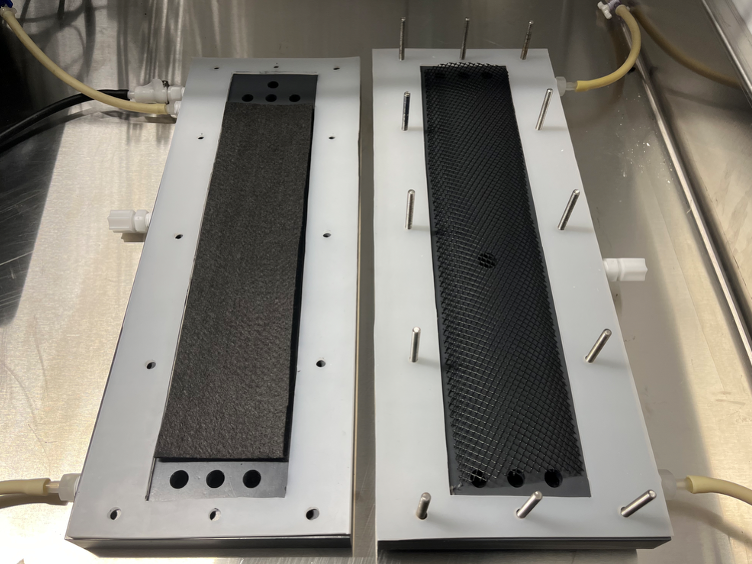
An internal view of the reactor system that efficiently converts carbon dioxide and renewable electricity into methane. Credit: Bruce Logan. All Rights Reserved.
<関連情報>
- https://www.psu.edu/news/research/story/new-reactor-design-produces-renewable-methane-carbon-dioxide
- https://www.sciencedirect.com/science/article/abs/pii/S0043135426004057
スケールアップしたゼロギャップセルにおける微生物によるメタンの電気合成 Microbial electrosynthesis of methane in an up-scaled zero-gap cell
Bin Bian, Xinrui Ma, Sen Li, Najiaowa Yu, Chenghan Xie, Wulin Yang, Bruce E. Logan
Water Research Available online: 9 March 2026
DOI:https://doi.org/10.1016/j.watres.2026.125723
Highlights
- Up-scaled zero-gap MES reactor achieved 6.9 L/L-d methane at 30 °C.
- Energy efficiency reached 45 %, among the highest under standard MES conditions.
- Hydrogen-mediated electron transfer proved essential for high-rate methanogenesis.
- Extended 30-cm flow path enabled uniform biofilms and efficient H2 utilization.
- Scale-up preserved high CE (>95 %) and stable Methanobacterium-dominated communities.
Abstract
Microbial electrosynthesis (MES) offers a promising route for converting CO2 into value-added products, yet low energy efficiency remains a major obstacle, especially during scale-up. To address this issue, an up-scaled zero-gap MES reactor with an extended 30-cm flow path was developed and operated under a range of applied voltages to assess energy conversion and methane production performances. Increasing the cell voltage from 2.3 V to 2.7–2.8 V boosted the current density by 131%, reaching 17.5 A m-2. This improvement produced a corresponding rise in methane production from 1.4 to 6.9 L/L-d, achieving high coulombic efficiencies (>95%) and one of the highest energy efficiencies (45.2%) for methane synthesis at 30 °C. Simulations underscored the key role of hydrogen as the mediator of electron transfer, showing that sufficient in-situ hydrogen generation was essential for sustaining high methane production in the up-scaled reactor. Microbial community analysis revealed minimal spatial heterogeneity along the extended flow path, with the cathodic biofilms consistently dominated by hydrogenotrophic Methanobacterium (59.8% and 50.5% at the bottom and top), reflecting stable microbial functionality under scale-up conditions. Overall, the results demonstrate that with proper operational optimization, MES can be scaled up effectively without compromising energy efficiency or microbial–electrochemical synergy, offering a viable pathway for CO2-to-methane conversion in up-scaled systems.